Comments, relating to the topic, are welcome, add a great deal to a blog, but must be in English, with no profanity, hate-filled insults, or links (unless pre-approved) To contact me with questions: rainnnn7@hotmail.com.


Wednesday, April 01, 2020

by Diane; Update #6, When best of plans fail

Spring is calling; my interest in topology wavers: my acrylic paint palette is hardening. I have an urge to finish my old projects.
       I framed and hung my recent topology inspired pieces with one small abstract I did in 2003. Going against my plan to not be critical, I became critical of the one on the white wall. I am falling back to my usual process of the way I throw myself on the empty canvas and mid way become critical.
        Looking through older work that had promise but never came to a finish that I could for long find acceptable, I added more color but the flow of the swallows flight still does not read well with the color and texture being more dominant than the flights. 
         Liking neither the tangle painting on the white wall or the swallows and tractor, I just recognized that the flight of the swallows could be described in topology tangles. Could I have stumbled on an application of math to describe an event in nature? I was inspired to change back to working from topology. Can topology be used to describe movement through time?
         The tangle painting that I did not like is now not a failure - just unfinished. I hypothesise that the swopping in and out of the swallows could be mapped to show that their flight patterns help them work the air together to catch insects to eat. Their flight route could be drawn in a a two dimentional projection like a topology tangle.  I am looking forward to doing more observations in this new way when the swallows return.
    This week I am much to absorbed in my art to be my husband's helper in his time of need as his neuron motor disease symptoms are bound to worsen. We are still navagating the medical specialists when most of their office have all but shut down. When the pandamic is over, we have great expectations of being included in a comprehensive clinic which will have professional advise for all his needs in one visit a month.


Saturday, March 28, 2020

There is a time

by Rain Trueax


Quarantining, hunkering in place, self-isolation... Whatever you call it, many are trying to stay at home and away from possible contagion with Novel Covid-19, the virus that seemingly arose from nowhere and is devastating families, economics, and social interactions. Jobs that involve the public and are regarded as non-essentials are mostly shutdown for now. Some National Parks are closing for now while they figure this out. Even the Olympics will be rescheduled for a year from this summer-- first time in an odd year as far as I know. 

Monday, March 23, 2020

by Diane: Art escape update #5; Painting play with Platonic surfaces

Brussel sprout
At a time like this I enjoy the little miracles that I  see in  my food preparation as well as important family and friend relationships.
       My husband and I are tremendously thankful for our amazing family support; our two daughters, one experienced a 5.7 earthquake at the Salt Lake airport, but waited patiently until the airport reopened and flew to Portland, Oregon. Needless to say I did little painting, with company and the important doctor's appointment about the future of my husband's neuro motor disease. We were uplifted with being able to together start making plans for future needs. In another couple of months we will have a better idea of our future time frame.
        My family is encouraging me to go back to landscapes even on large formats. The warm weather had me yearning to get out the oil paints. At the same time I was able to view the Great Course lecture by mathematician Professor Devadoss on the topological Platonic solids' surfaces. Part of the lecture was illustrated with a child's toy for constructing solids.  This week I can report that I am resisting oil painting from nature that requires more complete emersion and energy sucking process. Instead I am incubating ideas of painting the Covid 19 virus which happens to be in the shape of a Platonic Solid.

Bok choy


Red cabbage

Saturday, March 21, 2020

row your boat

by Rain Trueax

Row row row your boat
gently down the stream
merrily, merrily, merrily, merrily
life is but a dream.

Everybody knows the melody or maybe not younger generations but it is well known to older ones. It is credited to Eliphalet Oram Lyte, who is cited as its composer in the 1881 New York publication The Franklin Square Song Collection. It is thought the words have been around much longer.

It came back to me because of a book we are reading-- The Dude and the Zen Master


Wednesday, March 18, 2020

by Diane: Now is the time for me to shelter in place and day dream


This is my brain storming fantasy. In the year 2030 in the aftermath of some world pandemics, and populations fleeing the uninhabitable due to climate change, I witness the evolving of an ethical application of technology for a better quality of life.

In Rain's painting I see the the goal of my choice..
We can keep the best qualities of this preindustrial,
 loving community
in a high tech society.


A Science Fiction : My first vision of the possible: given that quality of life through community is a high priority

On my 87th birthday celebration my closest family and I will plant all the vegetables we will have to eat for the next year on a wall next to our neighbors' plots. One of my neighbors will be my doctor who along side of me is planting her or his plot. Every neighborhood will have a doctor. Doctors will practice medicine like an art for the sake of art not for the profit of an organization with no fear of being sued. Insurance companies have parished. DNA knowledge will  determine optamin health. Our sustenance will be from working together with our neighbors.
      We have reached a new point in civilization in 2030. Robots do the work nobody likes and all work that requires the human touch and heart is conducted like art.  Art for art's sake. Letters from family and friends living far away will be sent via technology. The roads not maintained and not needed with flying prevelent.
       We are still plagued by imperfect solutions. We are imperfect humans so all our doings will always need bettering to meet our future needs.

OK: My science fiction has more holes than swiss cheese: The point is I am directing my thinking away from "Ain't it horrible?" I do not blame politicians. Most importantly I am questioning what is quality of life and how do we get there?"

Saturday, March 14, 2020

putting it together

by Rain Trueax


Somehow, this blog is not coming out as i had intended...

Originally, I had intended to write more on MeToo. Particularly, I wanted to research if more info was out there on Congress's shush funds. Well, after some research, I got very little. These payoffs were only the part that the federal funds covered to stop someone from talking who had made a complaint, but they didn't all have to be about MeToo issues. There has only been $17 million paid out at the point I found figures. There was no info as to what it had covered or which Congressional employees. It also did not deal with private payoffs. Basically, I didn't feel I had enough to carry on with the subject. IF that changes in the future, I'll do more with it. 

I just want to add that it's good for there to be accountability whether it's movie executives, stars or political power brokers. There doubtless is still not enough being done.

So... what attracted my interest instead was another kind of cultural issue that was triggered by putting together one of my nighttime dreams, a popular reality show, and our political world. I was hoping I could write it in a way that made sense. 

Then,  I had second thoughts about that too based on not having the mindset to do it justice as well as all of what's going on with Covid-19, where it's causing such major disruption and has so much uncertainty attached to it. January 4th, I wrote about ['black swans']. The world has been hit by one of those with no idea where it's going. Not a good time for deep thinking where, at least for most of us, we don't have enough facts to put it all together...

So third plan. Photos of the desert and at the end a jigsaw puzzle, one of my current meditative distractions. Enjoy my piece of the desert where I find such peace and if i have to self-quarantine, I will enjoy my surroundings.

Wednesday, March 11, 2020

by Diane: I just realized my childhood doctor had the same Jewish principle as health care doctors on my father's side


I didn't see him as being Jewish, even when I had been his patient for years. The last time I saw Dr. Burnham I was 15. When I was 15 my parents and I moved from Berkeley, California to Portland, Oregon.

     In the 1940's my parents took me to Dr. Burnham Junior.  His office was upstairs above a street level pharmacy.  The art-deco waiting room was worn and past its prime. In places the wall paper was peeling. No Highlight Magazines or child's corner! I was drawn to the window watching students come and go through the University of California's Sather Gate on Band Croft Avenue. How ideal would it be for me to join them and read books outdoors under a shady tree someday?
    When I wasn't watching out the window, I studied the bold large tropical leaf wall paper on the opposite wall.  

      Dr. Burnham's Jr.'s office appeared to be his home inherited from his father's practice. His father was likely a Jewish, Yiddish speaking German immigrant. I remember my parents talking about the doctor's marital status but I didn't pay attention to the details. I saw no sign of his wife or children.

     The hominess of the medical office was complete - no reception office counter.  No-co-pays! No pay before service. The nurse welcomed us as soon as she was available. Her dress was one of the few sign that the home was a medical practice. Her uniform included a fascinating intricate starched cap, an immaculate white dress and white stockings and shoes. 

     When the patient before us was finished, the doctor showed the elderly patient bent over a cane to the elevator and then showed us to the grand room like a ball room in my childhood memory of sizes.  He was dressed in a suit covered with a white lab coat. Some details of the exam room were interesting enough for me to remember like an impressive collection of leather covered medical text books on shelves.  This was not a library. No doubt it was a doctor visit room because of the scent of rubbing alcohol and mercurochrome.  There was an exam table and tools on a cart.  There was a large glass container of cotton balls and another smaller container of tongue depressors. When needed, the nurse brought in the freshly sterilized hypodermic needles in a stainless steel container. By the door was a large black doctor's bag that showed wear and tear of many house calls. Also in the room were glass cases and shelves with bottles and boxes. The most memorable surgical tools were the scalpels. I don't remember him using his desk. He must have had a desk because I remember the lamp with the horizontal  kelly green glass shade and pull chain like the ones I had seen  in libraries. He sat in an easy chair with pencil and pad across from my mother and I where we sat together on a coach.

      For what seemed much too long my mother and doctor in a relaxed conversation talked about my symptoms no matter how insignificant. I cringe still remembering that strangers in the waiting room could hear every word. Yet, the doctor would get an almost whole view of our life – of course missing my input. children or seen but not heard.

     Dr. Burnham made as many as three house calls a day to keep me from having to go to a hospital when I had a high fever. He knew us like he was our neighbor.

        At the end of one memorable consultation when I was ten years old, he told my mother that I had cavities in my molars and they needed to be filled soon.  He boldly criticized my orthodontic braces. My teeth could not be straightened because there was simply not enough room for all my teeth.  Some teeth had to be pulled to have a success. His words that day remain in my memory because my parents did not heed them. Dr. Burnham Jr. was correct. My teeth are becoming more and more crooked.
       Looking back some aspects of Dr. Burnham's practice I truly miss. He probably billed his patients according to what they could pay. Though he was an authoritarian type, he healed through being theatrical. He had great faith in the body to heal if we would be just patient. He was not afraid to speak the truth.  I miss the personal involvement and caring that he expressed despite his outdated attitude that children should be present but not heard. Maybe worse is today's medical practices that protect the doctor from direct contact with the patient. Too many people and too few doctors. The primary care professional  deligates responsibility so many steps away from the patient, that the patient gets answers third hand.
      We did not have to deal with health insurance.  His biggest expense would have been just payroll for a nurse.  Most of his patients were his father's aging patients. He didn't care to make money beyond what he needed to live. He proved practicing medicine can be practiced as an art as opposed to practicing programed technology with minimal oportunity for heart felt connection. This history proves to me that we could have a more humane and less expensive health care whether we go with single payer medicare for all or less government involvement. Living the Jewish principle of repairing the world in his case through medical paractice could be more rewarding to a doctor than money. From what I know of the health care providers on my father's side the Jewish principle endures longer than observance.


Saturday, March 07, 2020

Me Too

by Rain Trueax

March Sunset from our desert home

Before I start on MeToo, I wanted to let readers here know that I have a free book at Amazon for Kindles. This is one of the benefits of making my books exclusive to Amazon (as well as that it can be borrowed for Kindle Unlimited members). So, if you have never tried a mystical realism novel, this is your chance for free-- Dangerous Match. It is supposed to show up free Saturday and Sunday but be sure it is before you hit buy.

~~~~~~~~~~~

While I no longer watch MSNBC for news, I used to have it as my go-to source. Even then, I wasn't fond of Chris Mathews. Something about his style of reporting turned me off. Still, when I read that he was forced out of his job there due to the MeToo movement, I read more about what exactly had happened.

Wednesday, March 04, 2020

by Diane, Fundamental lessons from studying painting at Portland State College during the '60's

At Portland State College I was given important lessons in practicing art. They were to look and see for yourself, have confidence in your instints, and be an engaged citizen.
        Painting Professor Richard Prasch recommended before starting a painting, reflect on what you want to acheive and list them on paper. So the past 54 years I have kept a record of my goals in one large binder. In that binder I found a 1975 letter to the editor.


Over the years there is a thread of consistency at Portland State College then and now Portland State University.  Paintings with social conscious content was praised and recognized.  The department provided programs for students to  reach out to the public like participating in the formation of an art gallery that had drew in participants from other disciplines at the college.
     I have dropped in to see thePSU art department several times over the years. With the retirement of the ceramics instructer, Ray Grimm, the ceramic studio  became small classrooms without natural light and offices for  instructors.  The central lounge  dissapeared.  The department office was moved over to what had been a basic design class. When Heidel was there, a large tapestry adorned the space behind a desk. Then during the 80's the painting studios were moved to an old commercial building. I can't imagine how painting in a low ceiling studio with artificial light would have been inducive to  the almost like outdoor painting problems. Sometimes I even painted from the balcony giving an Olympian view of the subject. Not to mention that the new cramped space would have fumes that would overwhelm me.
      An appolgy:  This blog is unfinished.  I intended to finish  with an explanation of how the Art Department's Graduate College of Art + Design had a cord growing out of the objectives of Heidel and other department heads in the 60's. Due to my roll as a care giver to my husband, I have yet been able to take up the invitation of Associate Director of Development and Alexandria Cleasby the Development Coordinator of PSU Arts. They offered to take me on a tour. With the slow progress and new issues in my husband's health, I do not know when I can take up their offer.


Saturday, February 29, 2020

Leaving a review

by Rain Trueax


 waxing moon from February 25th

Wow, it is the last day of February and a Leap Year. I have not heard anything spiritually important about it being the 29th, but kind of cool to see it. There was a time when women could propose to men in a Leap Year-- that was in the old days before that became a more routine possibility. 

We had a wonderful visit with my brother. After years with less time together than we would have liked, a week was a true gift. My mind then was totally on having as much time with him as possible as well as making sure he had some fun experiences.

Now, however, my mind is turning back to writing-- in particular my books and reviews. How much do readers understand how important their reviews are to books, that they are part of the reading experience? It's not just about sales but also letting readers know about stories they enjoyed as well as those they did not. Reviews are about a conversation as sometimes someone agrees or disagrees with a review they read. 

Wednesday, February 26, 2020

by Diane; Charter membership of Portland State University's White Gallery

1960 en plein air Humbug Creek
donated to
Oregon State Fish Hatchery and Research Center
      New hope soon followed after Professor Richard Muller shared his vision of a devastating, dwindling support for art and education when he just heard Kennedy was shot and probably dead.  The very next art history class Professor Richard Muller tapped half a dozen students for an opportunity which would forever benefit our life beyond college years. Based on our class term essay about our personal involvement in an art piece, we were selected to be charter members of a student run Portland State College art gallery. The members included Issac Allen (Isaka Shamsud-Din see Feb. 12 post), and a psychology student who had taken some art history.
    If  nationwide we do not support the arts and education, Muller would work to mae the arts a working part of the college's and the Portland public's culture.
    As secretary I recorded our ideas for a mission statement. Guided by Muller, we declared that we wanted to create bridges between the many academic departments at the college and the greater Portland public. The gallery would be in the student center in a highly visible hall leading to the caffeteria. Students would curate pieces from the college including revolving exhibits that would be shipped to the college from afar.  Jim Hibbard, a new instructor to the art department, also stepped up to help especially when we received traveling exhibits. He helped uncrate and then repackage delicate artwork. He also lectured to his elementary education students in the White Gallery.

All my Portland State College Courses and the White Gallery experiences impacted 55 years of my art choices

A demonstration at Corvallis Art Guild Clothesline Sale in the year, 2000 
from a visit to Humbug Creek 40 years after my plein air painting in 1960
Now hanging in the education room of the Oregon State Fish Hatchery and Research Center,
it is one painting in a grouping showing a family's involvement recording
artists' perspectives of the changes in Humbug Creek impacted by deforestation
     My seven page resume was organized to sell art, but could be organized differently to feature both my engagement in making a difference on the arts in my community as well as my frequent withdrawals. Often in the past my ideas are counter to the general culture and instead of pressing through, I give up. In addition I confess during some periods of my art journey I followed the notion that art making is only worthwhile if sold and somebody wants it enough to buy it. The first few years after graduation my mother was my agent and she sold so many paintings, I believed that my success would be to sell all that I make so I could keep on painting.
       On another level what is in accord with my education is illustrated in these Humbug Creek paintings. They are an example of one of my public displays. These paintings in a fish hatchery along with my mother's demonstrates our involvement in Humbug Creek's change from a vital fishery, its demise and restoration. I like to point to them as a healthy family activity when I am teaching watercolor at the Research Center's Art Festival.
     I am deeply sad that a classmate at Portland State College now speaks out against all education as being some brain washing machine stealing our freedom to see reality. I am sad that small colleges are shutting down.
     I believe empowerment of our ability to see as an artist begins early. If we are taught to stop thinking our perceptions are valid as toddlers, we are forever susceptible to being deceived. My topic next week will be letters I wrote to the editor where I was calling out educators who were wrongly using art to stop children from trusting their own seeing and believing an authority. These teachers did not have the good sense art for elementary teachers taught by Portland State College's Robert Colescott or Jim Hibbard.


Saturday, February 22, 2020

busy week

by Rain Trueax

(Oops, I thought I had made this blog live. Well it has been a busy week lol)

This is a busy week for me with my brother visiting for a week. I am so happy to have him. He and Ranch Boss have done more things together than with me as I am still having foot problems-- as well as being totally out of condition. It's been great for all three of us as we are pretty much compatible. Until this opportunity, I haven't been with him as much as I'd like as he lives in Portland and when in Oregon, we live about 90 miles away in the Oregon Coast Range.

At any rate the only thing really going on with me is time with him, great conversations, I might add, writing, and what I see is going on with politics. Oh, we have watched some great movies together. My favorite was Murphy's Romance, also set in Arizona.

The photos are one of the things that we've done with my brother (Casa Grande Ruins National Monument above) and the wildlife cam at our Tucson house. This one is set to look up from a small draw that is on our property. The building beyond is the end of our Tucson house where the shop and storage room are. It represents part of what we love about being here-- sharing this place with these denizens both are night and during the daytime.


We had a front view of the bobcat last month.


Wednesday, February 19, 2020

by Diane; 1966 PSC graduate connecting with today's Portland State University's Art + Design School


The stench of the San Francisco Bay at low tide, smog in Los Angeles, and racial tensions among classmates at Portola Junior High School used to be vivid memories when I entered Portland State College January 1962.   I found faculty  had concerns that reinforced mine.  There was Robert Colescott who also came from the San Francisco Bay Area, and Florence Saltzman who had lived in Los Angeles. The Dean of Social Work, Dr. Gordon Hearn had taught at the University of California, Berkeley just before coming to Portland. Probably there were others from big cities who could see that  Portland was on its way to becoming a metropolis.  So the administration and faculty were motivated in taking part in shaping the growth of the college open to and involved in the growth of the city.


       My Freshman year in college I did a preparatory drawing for a painting that humanized the concrete freeway with a man on a stairway between merging lanes onto the Steel Bridge. The selection of my subject was a repetition of similar images that I did at Woodrow Wilson High School in Portland. The earlier Berkeley, California's freeways were memories.  My Portland State experience built on some of my concerns from having lived in the San Francisco Bay Area. The summer of 1962 the oil painting hung in the gallery facing the administration office. I was happy to sell it to the wife of an Oregon Health Science student.  This of course did not please my painting Professor Fredrick Heidel who thought students needed to keep their college work to inform for years to come their development as artists.

        I graduated from Portland State College in 1966.   Then I continued to be constatntly aware of my college memories. My formative years continue to feed who I am today as an artist and citizen.  February 7, Kailin Mooney and Alli Cleasby of the PSU Foundation came to Albany to share the direction of Portland State University's Graduate School of  Art+Design.  I  was delighted to learn that Portland State University's holistic encouraginging interdepartmental connection are healthy and growing despite devastating cuts in governmental support.

     Portland State College Portland community outreach increased during the 1960's.  I was privileged to know the Art and Architecture Department Chair Professor Heidel, and the Social Work Graduate School Dean Dr. Gordon Hearn, as well as making the acquaintance of the Chemistry Department's Chair Dr. Johnson. And I had limited contact with other departments that were all unified by PSC President Brandford Millar.  I had the good fortune of meeting PSC President Brandford Millar on several occasions while being a student and after my graduation at a wedding of one of Dr. Gordon Hearn's daughters. At the reception my mother bragged to President Millar that since graduation a year ago, I was selling most of my paintings. He made a face of disgust.  He said he wouldn't be impressed unless I was selling pieces for thousands of dollars each. The college's purpose was not to produce marketable artisans.

      Being friends with the Dean of Social Work's family, I was invited to serve tea at informal gatherings of students and faculty.  I met Social Work graduate students.  I met a music and math student  who was a friend of the Hearn's son, both majoring in math. My memory is hazy about who among my acquaintances was concerned about the rituals around death and thought about how the process of grieving and public memorials could be made without it being a business for profit.

"Opening Heart"
 in which parts of the continuously
encompassing knot dissolved.
It is #5 in a series
 of mathematical  topology knots. 

On a personal level since graduation the thread of my Portland State College art education runs a circuitous route both through my painting process choices and my conduct as an artist / citizen.

     PSC and my mother's example instilled in me the feeling of responsibility to share my art in community service.  Currently  I have an exhibit at the Albany Public Library through February. Then in March and April l will be showing on the ground south hall of the Corvallis Caring Place Assisted Living.  "Opening Heart" will be in the Corvallis Art Guild exhibit with about 20 pieces.

    I also volunteer to teach watercolor once a year at the Oregon State Fall Creek Fish Hatchery and Research Center's Arts Festival.

  When I am painting, I often listen to what I think my painting instructors  said.  Fredrick Heidel said to make it easy to set up yourself to paint.  My latest series of topology knots, was not going well so I listened to my memory of professor Fredrich Heidel saying,  “If a painting is not resolved, a transparent glaze can pull the painting together.” Heidel was fond of Shiva Rose Red. The Shiva company went out of business so I substituted a little Quinacridone Red in mostly Liquitex Gloss Medium.


My sore wrists and shortage of time is aided
by using a recycled cookie container and empty glass
Yoplait Yogurt containers. Thank you Heidel and his wife Florence Saltzman for recommending easy set ups.


 A few years after graduating from Portland State College, the art department sent out questionnaires asking what our transition was like going from academia to making art out in the world. I sent a cartoon of me in hiking gear with a camera tripod topped by a drawing board. 

To sum up my Portland State College experience, I carry with me memories of  my instructors and fellow students at Portland State College.  The experience continues to inform my art and my curiosity. While visiting Denmark and Norway I photographed their use of light in architecture and lighting fixtures.  In Paris last year, I traced the foot path of Henri Rousseau to the hot house gardens where he drew inspiration for his painting "The Dream." The banner for this blog is a detail of a painting intended to be a present day version of Rousseau's painting.
 

Saturday, February 15, 2020

the day after Valentine's Day

by Rain Trueax


If I'd had a blog day for the 14th, I might've written about romantic love between people. What is it? Is it real? Does it last? etc. etc. But this is the day after the day devoted to romance (and buying cards, candy and flowers), and I don't have any specific subject in mind. 

Usually, I start thinking of blogs, sometimes weeks ahead of time, but this time, it was Tuesday and nothing had popped into my head. Then I saw this article. 


It's a very real prejudice that some would never read a romance novel, but they have no idea what is even in them-- since they never read one. OR they read one from years back, when as that writer suggests men had more to do with what made it into the novels than what evolved once writers took charge through indie publishing.  

Romance novels today vary for what they have in them. Some are virtually novels with complex problems for the characters to work through. I prefer them for my own reading. I like to write and read a story where the main characters are working through something to which most of us can relate. Sure the romance is fun and at the heart of the story; but if that's all it is, it becomes boring to me.

Why can't a romance novel inspire us to deal with issues we also face, as well as entertain? Isn't it nice to have a story where we know the ending will be happy? When it's historical, it can reveal what life was like in a bygone era. When it's contemporary, it can have emotional issues where we can relate-- even if they are not ours. 

There are romance novels where the story is all about the romance for those who need that moment of escape. Fortunately, today, there is room for more complex stories where there are readers who like that too.

Wednesday, February 12, 2020

by Diane: A visit with both PSU Foundation Associate Director of Development and PSU Arts Development Coordinator

1962 during summer vacation
Friday, February 7, I shared a few of  my memories of the Portland State College's Art Department in the 1960's with Portland State University's Foundation's Kailin Mooney and Ally.  Then they told me about the developing School of Art + Design graduate program.

    I believe for over 55 years there is a strong thread of continuity.


To the left is Issac Allen
Soon after he changed his name to Issac NoMo because his real name and roots were wiped out by slavery. He has come to identify himself as Isaka Shamsud-Din, artist, educator, Black Muslim and activist. His on line resume connects him with the King School Museum of Contemporary Art. The  student run museum brings national artists to the school for student workshops. The museum serves economically under priveledged students who would otherwise have no art exposure.
      In 1963 I felt uncomfortable being the only student being photographed, so I invited Issac to stand in a silly photograher's choreographed pose. Luckily never published in the Oregonian! Obviously not Issac's or my most comfortable moment!
In the photograph to Issac's left are me in the middle and my mother Margaret Widler.
       The photographic session and interview was by The Oregonian newspaper to promote a student sale to benefit art scholarships. The idea of having a student sale to fund student scholarship was  mother's idea.  As president of the Mother's Club she brought about and organized the event for several years.  She was sharing her art entrepreneurship that went way back before she worked her way through college during the depression at the University of California, Berkeley. This was her way of supporting me! She had the best intentions of sharing her enthusiasm for art education: The results were mostly good.
     Being photographed for a featured article in the Oregonian made me giddy.  Not Issac!  Issac also had identity issues searching for who he was.  The art market to him was dominated by white culture, he was unsure if he could survive as an artist because he was black. He was not excited by the student sale.
         Issac already had a mission in life to document his experiences as a West Coast black man and a survivor of the Vanport flood that had destroyed Portland's African American neighborhood. He was a few years older and far more mature than I was.  I remember the figure paintings he did under the instruction of Robert Colescott. Issac was painting the African American experience before his instructor embraced his identity and expressed it. But later after a trip to Egypt Colescott became a renown African American painter who depicted the hypocracy of African American sterrotypes.
       The sale of my painting at the student scholarship sale boosted my ego. But Issac did not sell his heart felt, expressive painting about Vanport; he was very, very discouraged. Not even the sale of his ceramic pot to my mother was compensation.  His pot expressed his soul beaten and scarred on the exterior but soft warm melted chocolate on the inside. 
      After the sale Heidel spoke to our upper division painting class.  He tried to comfort Issac and others who did not sell. Heidel said that it makes no sense what sells and what doesn't. Sales have no bearing on the authenticity and value of our paintings. Heidel's intention was to make art vital to our life as artists and a vital positive force in the Portland community.  In other words PSC art curriculum was not trade school preparation to train us as producers of saleable paintings.
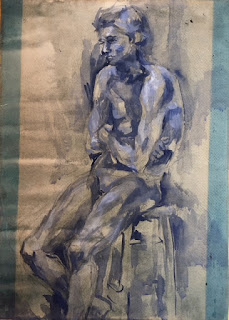
Completed in
Figure drawing and painting class
Instructor Richard Prasch
1964
If not the goal of instructing students on how to make saleable paintings for the art market, what was department head Heidel's vision for Portland State's Art Department and Portland?

        One precious part of my Portland State art studies was mentorship with artists who had a rich creative process. Frederick Heidel, Richard A. Muller, Richard Prasch did not demonstrate how they personally drew or painted. I didn't even go to galleries to see what their work looked like. They shared their process through assignments while allowing me to try different ways of putting down marks and paint where my intuitive voice seeped into my work. Heidel would gently steer me away from my own departures  made for shallow reasons.  He believed I had my own story worth expressing.
       My three mentors didn't have rules or techniques but posted examples of masters of painting from history.  As I was leaving Oregon after finishing at PSC, Heidel told me that he hoped he had not damaged my intuitiveness. I was an intuitive painter when i didn't know what that meant. He said do not make academic paintings. Do not make studies.  Make every painting yours. Do not sell your work because you will need it as references as you develop. Have a rich art development.
      My development in art is now richly satisfying to me despite having sold important pieces. In some cases I arrange to get them back. As I have selectively adopted values of the PSU faculty to my life, my creativity expands to approach life's challenges.
       I thank my mother and faculty at PSC. Basic Design instructor Jean Kendall Glazer asked us to trace our path on how we move through our kitchen. I have expanded her ideas to how I move through life as being an artistic choice. My thinking has evolved to considering my values. And beyond to the opinion that we live in an art creative desert. Creating art is a basic human need. If everyone felt empowered to express their intuitiveness through the arts, the world would be more paeceful. Jealousy, greed, and violance would fade away. 
     
November 22, 1963,  I remember Professor Richard Muller deeply shaken when he arrived late to our art history class. He announced the shocking news that President Kennedy was shot and most likely dead.  He feared  his optomistic hopes were destroyed for an enlightened future for our country. He was worried that the support of education and especially art education had just received a death blow.
         Optimism had been high.  Portland State College had its first graduate school - the School of Social Work headed by Dean Dr. Gordon Hearn as well as an idealistic Art and Architecture department headed by Professor Frederick Heidel. Optomism soared with the presidency of Robert F. Kennedy's support for education and the arts. PSC President Branford Millar declared that we are Portland State College now but soon to be Portland State University. Our belief in our exceptional goodness in the United States was cracked by the assasination of President Kennedy.

Never the less the hope continued.
         The day President Kennedy was shot Professor Muller returned our term papers on the topic - a record of involvement in a piece of art. I believe a few days later in the next class session some of us were invited to participate in what Muller thought would be an important bridge to us becoming art citizens in our life beyond our college experience - a student run gallery. Six of us including Issac Allen and a psychology major started The White Gallery. A mission statement was our first task. Next weeks blog will be more about Muller's project that relates to the thread that continues today. 


Saturday, February 08, 2020

intolerances-- to food

by Rain Trueax


This is going to be a fairly short blog as I've had an 'under the weather' week. How did this come about you might ask or prefer not to know. For the prefer not to know, do not hit the read more button. 

Wednesday, February 05, 2020

by Diane: Update #4, Care Giver's Art Escape

The past week had my mind spinning, running about from one doctor to another with tests in between.  Then in addition Monday at noon my husband accepted an opening for an overnight fitting for a C-pap machine. He slept through the night which was phenomenal for him. But now we have to wait until the end of February for the results. Unless there is another opening!
       To my relief the painting palettes and found stamps proved to be exactly right for my life. One of the circles is made with the cardboard protection for a spark plug that a neighbor helped to install in our Toyota pickup. At the worst time the truck's transmission went belly up. Through all the distractions, my painting experience was better than I expected: I could paint a little every day for at least a few minutes.
        I like the linear quality of knots that I discovered in a math course about topology, a branch of geometry. Professor Satyan L. Devadoss' THE SHAPE OF NATURE is a video course from The Great Courses designed for not only people engaged in math but also for history buffs and even artists. I am amazed that I am getting a rudimentary understanding of my father's math hobby. I  am comforted feeling closer to him.  I have his wisdom in how he took such good care of my mother.


Saturday, February 01, 2020

Imbolc

by Rain Trueax


For those of us who celebrate a Celtic year, Imbolc (in the Northern Hemisphere from February 1-to the evening of Feb. 2) is the true beginning of spring (It didn't occur to me until last year that it would be celebrated August 1st or 2nd in the Southern Hemisphere as it is a seasonal holiday). It is midway between the Winter Solstice and spring equinox. 

Where I live, it marks the beginning of lambing season although our son, who looks after the livestock while we are in Arizona, had the first lambs weeks ago. Imbolc (you do not pronounce the b) means ewe's milk. Whether on a farm or not, this is the time of stirrings of new life, what might be called the quickening when life comes back from where it's been dormant.