Comments, relating to the topic, are welcome, add a great deal to a blog, but must be in English, with no profanity, hate-filled insults, or links (unless pre-approved) To contact me with questions: rainnnn7@hotmail.com.


Showing posts with label communication. Show all posts

Saturday, October 06, 2018

reality versus how we might wish it was

by Rain Trueax

For this blog, I tend to write articles ahead of time, as ideas come to me. I had one planned for today and changed it after my friend, Diane, wrote her piece about her own experiences with sexual abuse. I felt her bravery, and yes, it takes bravery to share such things, meant I needed to change my own plans to address some thoughts on what has been traumatic for our whole country.

Here is not where I want to write about the recent hearings, guilt or innocence of anyone involved in them, but rather the subject of sexual abuse, ramifications on a life, my own experiences, and how thinking about the subject and its impact on adults led to one of my books.

Saturday, July 14, 2018

popular or not

by Rain Trueax


Sometimes I dream something and wake with an associated idea-- sometimes only roughly associated. It happened this week. My dream had taken me back to high school relationships and one particular one where the dream mixed real life experience with fiction. 

In high school, I'd had a friend, the kind we did things together, had sleepovers-- and then one day I went to school and she was no longer talking to me. She never told me why. I never asked. To this day I don't know although I could hazard a guess. More interesting to me would be-- why didn't I ask then? I didn't and won't ever now. Her loss was painful for me as I didn't have a lot of school friends. The dream encompassed this real life experience but gave it a different ending-- think Hallmark ending ;)

When I woke, it was with this thought-- I am not a popular person. Is that why my books are not popular? Do they even relate?

Wednesday, December 27, 2017

A seventy-four year old attempting to stay current with a voguish vocabulary

 
 Feeling like a dinasaur, not understanding the younger generations language the same as mine, I look up their words. Not understanding the language on the media I refer to Wikipedia and online dictionaries. Then I make a flip card lexicon.


With the New Year approaching, I decided to turn a new leaf. I would act completely out of character wishing my grandchildren with pop culture language with these sentiments:
  Have a "RAD New Year. Bright as LID s on high! Without Fucking circuit breaking!
 
https://qz.com/119200/oxford-dictionary-adds-twerk-derp-selfie-phablet-and-more-voguish-vocabulary/

Saturday, November 25, 2017

Inspiration, Craft, Tools Part II

 by Rain Trueax

No matter how fantastic your idea and inspiration might be, if you cannot convey them to someone else, they remain yours. Basically, a need for craft is true for most of the arts.  Of course, there are natural born talents who create a new way of presenting their ideas.  They are rare.  Most who write, for example, have either taken classes or studied extensively with manuals that teach basic grammar.  Only when you know the rules can you break them with purpose. The big thing in writing is the need to convey the idea in a way someone else can understand.

The case has been made that sites like Twitter are creating a whole new way of communicating, using initials and symbols.  My personal belief is the only ideas that may be communicated that way, are shallow. Yes, the first humans used pictures and then hieroglyphics. In many cases, we are still guessing what they meant.

For those who want to write a book, it is important to take time mastering punctuation, spelling, and sentence structure.  There is a lot to learn to write in a way that does not takes the reader out of the story.

Of course, this is tougher the more educated the reader might be.  An English teacher will have higher standards and is more apt to be bothered by misuse of words, commas, and sentence structure.  Issues like split infinitives will likely pass right by many readers-- if the sentence still makes sense.  Dangling prepositions bother some readers, while others may find avoiding them more disturbing to flow of the story.

For me, writing dialogue is the most fun-- with the least rules-- other than make sure each character speaks in a way that is consistent.  To give readers a sense of character by how the person speaks can be a challenge but even more is stimulating.  Even there, craft plays a role that goes beyond inspiration.  Writing a scene where the word said appears too many times will break the flow.  Craft is really all about maintaining the flow.  Learning to make a scene project the qualities desired in the characters is a mix of rules and inspiration.

Besides grammar rules, there has to be an understanding of the requirements for each genre.  I think this is best done by reading a lot of books in that genre.  What readers of science fiction or mystery will accept will not be the same as those reading serious novels or romances.  Since a lot of writing today involves a mix of genres, some standards will not be consistent.  This is where inspiration comes in.  New standards for successful writing evolve as does the culture.  That does not mean that I believe LOL belongs in any novel unless the character is typing an e-mail.

One of the cool things about computers is how many articles can be found on requirements for successful writing.  When in doubt about something like the Oxford comma, I can tell you, with confidence, that you can quickly find articles that contradict each other.  In the end, you may know the rules and still break them IF you have a good reason - -one that benefits the flow of your story.  You will still not please that English teacher.

So learn the craft, read articles like this one, [10 Rules of Writing].  Craft may seem less interesting than inspiration, but it is the bridge to anyone else reading your work.  There are many ways to learn it. I worked one year with a consulting writer, who I had been advised by an agent would improve my romances.  This was in the Nineties and even then, it cost about $1500.  I would mail her typed pages of my work in progress.  She would mail them back, highlighted, with extensive notes in the margins.  That work with her was like a class in writing romances, where there are important expectations.

What I advise to any wanting to write--write, I will add to that-- read books on writing.  Read articles on writing technique.  When you get reviews on that book, your craft will often be remarked upon-- negatively is most apt to show up.  It may not seem as important as the inspiration behind your book but without it, nobody else will know because reading it will be a struggle they are not willing to endure.

I think some of this is going to be harder for the generations growing up in a time where learning proper English is not part of a full education.  When I was a girl, we learned to diagram sentences.  It taught us the parts of a sentence to make it work. We learned to [correctly use tenses].  I keep a cheat sheet by the computer to remind me of the rules. A comma in the wrong spot completely changes the meaning of a sentence.

All of this matters a lot to a writer but also, to someone writing a resume.  My hope is that some educational shortcuts will be reconsidered.  Yes, a computer can correct your spelling-- if you are anywhere close to the right one. It does nothing when you have to write something in longhand. Yes, craft doesn't seem as exciting to read about or take the time to learn-- especially for those who have come to believe a tweet can say it all.  I have two words for that-- it cannot.

Finally, there is the form the story will take.  While this might seem to be under the heading of inspiration, there really is a form that is classic, that satisfies a reader, and which takes some experience to master. In my early learning about how to write a scene or chapter, I heard about the W.  What this means, is that (this is true for paintings also) when you have a time of excitement, you need a time of rest-- hence, the W.  The characters go toward a negative time and then have a respite.  Romantic moments are followed by stressful ones.

Joseph Campbell (a link to his work below) spoke of the hero's journey.  This is the structure of mythologies which have survived time. In terms of basic adventures, there are only a few that can be used over and over and in different ways.  The hero's journey will have certain key points, which writers can learn, using what most applies to their work and what they are trying to create.

It is true today that some so-called literary novels seem pointless as they meander whither and yon with no real seeming ending or purpose. They are sometimes even called classics. The thing is what a culture decides is a classic lasts until a new generation takes over. Our own generation does not get to define a classic for more than itself. I think those who learn forms that carry forth universal themes, their work is most likely to hang around.

A few recommended books on craft:


Next Saturday, inspiration. :)

Tuesday, September 01, 2015

change is inevitable

 South Dakota Christmas 1901-- my grandmother is second from the right.

August on this farm was about the garden, heat, irrigation, smoke, hoped for rain, and computer problems. Since 2010, I had happily done all my writing on a laptop-- Windows Premium7. It's a great work machine or I should say was. I don't need a lot of frills. The important one for me was Corel Photo-Paint7 which did everything I needed to make covers. Corel is why I didn't update the machine to 8.1. None of the later Windows would let me use that program.

I have been through the computer rodeo enough times to know nothing lasts forever. So last summer, we bought a Win 8.1, with the idea I could eventually use it when my 7 failed. I left it though to Ranch Boss to do the adding of my stuff to it. Then it'd be ready when the day came.

For those who love every new technology, my Luddite attitude, toward keeping whatever I have as long as possible, probably makes little sense; but I am that way with everything. If I like something and works for me, I don't want to get rid of it, which explains 10+ year old jeans and sweaters.


What I didn't expect is that Microsoft itself would destroy my 7. They did it with their latest updates and the warning that they would no longer support 7. When I had one of their insisted necessary updates, and it caused the machine to fail, I looked toward what used to be my fail-safe program-- system restore. It no longer existed. By their planning, the crash took it out.

Grandpa is standing on the stump and grandma has that coy look on the front. Her mother with the silver hair is right behind her.

Although I had hoped we could find a fix for 7, it was looking like it was done. First though my rescue machine, the Windows 8.1, had to be updated to 10. For awhile, we tried simultaneously to fix the 7, but I am editing a manuscript and when 7 failed that-- I gave up. I had fortunately spent one week-end saving everything important to two new 128GB jump drives. It was tedious work, but with all of our photos preserved (my manuscripts were always updated regularly to the small drives), I was more sanguine about 7 failing. 

There are things I don't like as well with the Win10. I've had to get used to how it saves as it would be easy to over-write, but one of my big concerns was eased when I was able to buy a Corel Photo-Paint 7x and found it had most of the features I used. 

We ran into one final (I hope) problem, when in the midst of going to one of the photo places where I buy cover images, our Internet server refused me connection. Ranch Boss spent a lot of hours trying to get it back up. He finally resorted to calling our server. It turned out the technician there had been getting a lot of these calls in the weeks since 10 came out. He walked the computer through what needed to be done and for now, the Internet is back.

Frustrating to say the least especially since Microsoft could have told those with Windows 7-- don't update again even when we say you should for security. I am sure those with Macs are smirking about now-- but your day may also come. It's the nature of the Internet world that change is one constant.

My grandmother and great grandmother with no idea what year

My awareness that life is also that way was enhanced when I was saving those photos and saw again those of my grandmother, my father's mother. Mary's mother and father were born in Germany and immigrated. She was born August 22, 1887 in South Dakota. They were farmers and did well as her engagement and wedding photos seem to indicate. My other grandparents had no wedding photos at all let alone engagement photos. 


Mary and John were married August 23, 1903. I know more about her life after my father was born through his stories, but almost nothing about the girl she had been, what she wanted from life, what she experienced before she married. She was such a girl when she married. Was she crazy about him? I know she was after they married.


They had five children; lost one as an infant during a terrible South Dakota thunderstorm. I know that her reputation for a clean home was that you could eat off her kitchen floor. My father remembers watching her and his father at a barn dance, where the children were in the loft to supposedly sleep. She left her home in South Dakota to come to Oregon because of my grandfather's health.

They came first to an area not far from where I live today, but I never knew any of that until we moved here. I know when they were in Falls City, she nearly died from sleeping sickness, and had all her long hair cut off as evidently that was what they did in those days. When she finally woke, she cried over the hair loss-- or that's how my father remembered it. She later got breast cancer and survived it. She lost her husband with a stroke and wept on his casket. 

The thing that gets me now is I don't think I ever knew the woman she was, and I wish I had. She died April 1976 before I thought much about asking questions of her, before it seemed important to me, while I was very involved with raising my own children, and a year and a half before we moved to this farm.


my grandmother, uncle, grandfather and two relatives but not sure who

Much of the joy and fun I saw in her earlier photos, ones I only inherited when one of my younger cousins died, I can't say I knew. I did know her to always have long hair that she braided into a coronet around her head-- and if she ever wore a pair of pants, I never saw it. 

One of the things I have been most grateful for in my life is having had two such different grandmothers as examples of how women can be. I knew my mother's mother far better and heard her stories of her youth, her courtship, but the grandmother whose wedding photos I now have, well I don't think I really knew more than the image of her. It's a regret I can't undo now. 

I am not one to think often about my past or what has been. There is a reason for that. When I do, I feel sad and even teary as I miss what was. My growing up was good, and I am glad I knew it was good back then. The same with my years of raising children. I can't live there though and dwelling on the past just makes me feel bad in the present.

For this blog, I didn't know what I'd write and it seems ironic to me that it ended up being about the most modern of technologies and the oldest of mythologies-- who our ancestors really were.

Wednesday, June 11, 2014

from another blog


This is a topic I wrote about for Rain Trueax but readers here might also find of interest-- 


If you go there and have an opinion regarding the subject, be sure and comment-- here or there. I think it's a topic that could be debated with opinions other than my own or those I quoted there. :)

I might start posting a link here on Wednesday to what I thought most interesting from there or other places-- along with a photo or two, of course.

(The peacock has been quite noisy along the creek sometimes especially at night where I could swear it's a tropical environment instead of the PNW. He wants the wild turkey hens to come to him but they aren't around. I hope the cougars didn't get them all. Poor lonely guy but getting him a peahen would probably only end up with her dead-- hence he struts his stuff, stays along the creek, runs from us, and has to live out his days a magnificent lone male with no mate-- definitely suitable subject for a 'literary novel' lol.)

Saturday, December 07, 2013

Tamastslikt and Tsagagalal


To conclude my mini-tour of some of Oregon's more interesting, back-of-beyond places, I thought I'd combine two that fit particularly well together-- Tamastslikt Cultural Institute and Tsagagalal. but add there were three other interesting museums we visited while in the Columbia River Gorge--  Maryhill Museum of Art Fort Dalles Museum and The Columbia Gorge Discovery Center 

Each of these places provided pieces of the story of man's migrations from the first arrivals to johnny-come-latelys. The collections of artifacts could do a blog all on their own but I feel I've taken enough space here and will only cover the first two with links to all five; so you can know about them also.

While we visited these museums, we parked our trailer at two different state parks on the Washington side of the Columbia River. Our site here was right on the Columbia River and a pure delight. We moved when we wanted to see Tsagagalal for reasons I'll mention below but that site was nice too at Columbia Hills State Park.


 Maryhill State Park
From the first one we opted to leave the trailer and drive east, up the Columbia River and past Pendleton past the site of the Wildhorse Casino to the Cultural Center. Tamastslikt was built by the Umatilla, Cayuse and Walla Walla tribes to tell their story in this lovely and well put together museum. 


The unfortunate part of it is once inside the museum, you cannot take photos. I think it was a mistake as if they had not permitted flashes or limited the photos to areas that were not involving their spiritual beliefs to keep them sacred, it would make sense; but to block them all makes it harder to share what is there. This could be one reason there weren't many people in the museum. 

It is an excellent telling of how people lived before the white man came, how horses impacted their culture, their traditions (which during the summer would involve live demonstrations). They had a long house and often there were recordings playing to tell their stories. They then got into how they were impacted by the arrival of the whites and finally who they are today (my two nieces are one-quarter Umatilla but live in the Portland near their father, grandmother and other cousins).

I particularly liked in the display how they included the warrior side of that culture which often gets glossed over. These peoples did have a warrior class as did many of the Plains Indians. It is a proud part of their heritage. It has carried on with their people serving bravely in the military.

Walking through the dioramas and artifacts takes about an hour and a half, and I think is well worth anyone's time to get a picture of what another people lived like and what they went through culturally to get to where they are today with their goals for the future.

As someone who seeks out petroglyphs, Tsagagalal, She Who Watches, had long been on my someday list. She represented a god to the peoples of the Columbia River Basin, a huge, beautiful petroglyph overlooking the Columbia. Since she is above what were some of their burial grounds, some say she related to that, possibly to illnesses or death. She never seemed that way to me as I saw her as just beautiful and feminine. Legends abound as to how she came to be here. You can find them with a Google search.

The way you see her today is call the park for a tour which is limited in size and only happens twice a week in spring, summer and early fall. We got in on one of the last for this year. We moved our trailer to stay near the site.

Besides Tsagagalal there were many other petroglyphs in this park, all just above the Columbia River. Some are easy to visit without a guide and were saved before  Petroglyph Canyon, now underwater was flooded by The Dalles dam. They line a walkway and many of them I had seen drawings of other places without knowing from where they had come.

Some think they know why the people created this or that image or what it means. I just enjoy them for the way a story was left behind for future generations. Whether it was a mystical story, a hunt, something precious they had seen, petroglyphs all around the world are always worth a visit when possible.


 To me though, who has seen a lot of petroglyphs all across the west, the queen of them all is She Who Watches and she truly does appear to watch in her serene beauty.


 She is three feet by four feet in size, both petroglyph and pictograph.


Saturday, January 26, 2013

Can't we all just get along?

Three Sisters, Central Oregon, near Sisters

My opinion is most likely, no, we cannot-- IF we have to have our way, IF there are deep, core differences in our values, IF one of us wants to unfairly take what another has (which could be freedoms or material goods), IF we feel threatened, IF we see our cause as greater than anyone else's, IF we will win at any cost-- then we often cannot get along. We have to find a way to live with that fact.

Even in tribal peoples, basically they have/had someone who ran things. That was the one who decided if they fought a war, moved their camp, forced someone from their group. In some tribal situations, there would be one leader who ran daily life while another ran the spiritual. 

There was a reason a leader was agreed upon, maybe even chosen from birth-- humans don't get along real well. We are individuals and even for those raised within a tribe, those differences can still lead to conflict.

In a family, we see where some get so angry at others that they no longer speak. Agree to disagree means having to let something go-- not just stopping arguing for the moment but literally letting go the fact that two don't always agree. Some people simply have to convince others their way is right and the only way. Some will die/kill to further their causes and there is no way they can accept someone who sees it otherwise as having equal validity.

As a culture we have a Republic where we vote for leaders and what do we see happening-- one group trying to rig the system so they win power through whatever method it takes. Do they care if they have the will of the majority? Absolutely not and currently are gerrymandering state after state to win elections with the minority. Their latest plan would have had Obama winning 51% of the popular vote but losing the Electoral College.

Two recent examples of how we don't see things the same way:

When I watched the President's inauguration, I thought he gave a powerful but actually generic speech. He didn't nail one side or the other but said we should all respect each other, understand we all have value. There was more, but basically it seemed like a no-brainer. 

That wasn't how the right wing saw it. They saw it as an attack on their values. It was hard for me to understand. They wanted him to agree with them, agree with the principles on which so many of them ran and lost. When he did not, when he espoused other principles, it enraged them and some, like Ted Nugent, are now talking revolution again. Don't believe me on that? Listen to them on their punditry shows. 

Another example was when the right wing grilled Secretary of State Hillary Clinton on Benghazi. She was using logic and the tea party types who challenged her were ideologues. When she got frustrated enough, she said, why does it matter why it happened. What matters is what we can do to make sure it doesn't again. Good Lord, you'd have thought she just suggested crucifying Christ again.

Their purpose was political, partisan power. They kept harping on four people died. Three of those who died were paid to protect. They were warriors. They were mercenaries you might even say and in this case in the pay of the CIA or State Department. They were there to do what they could to keep the Consulate and Ambassador safe. The Ambassador died from smoke inhalation, almost a fluke death as nobody deliberately tried to shoot him. One of the operatives did also. The other two from rocket fire. 

Exactly what was intended by the attack is not yet known. What we can pretty well determine is that the arms they used, their training, what is happening in Africa is a result of despots being removed. Sadly leaders like Gaddafi kept order at a terrible price in terms of human abuse. Now their weapons are being spread among terrorist organizations and Mali and Algeria are also feeling the effect.

That was logic. An Ideologue instead says-- if I was president I'd fire you for those four deaths. That guy doesn't care what happened. He cares that he can pontificate (a guy incidentally who will NEVER be president). One of the men Kerry addressed the next day admitted he was out there posturing but had not attended briefing meetings. 

That's the two sides of this-- one to posture and scream. The other to look at what we do now. How do they get along? A clue-- they don't.

Theoretically when we vote, doesn't that mean it's settled until the next election? Not hardly.  The arguing wouldn't be so bad if we could even apply the principles that just won that election to see if it works. It doesn't happen. 

We don't even see the word fair equally. It has become a partisan term that infuriates some to even hear. To them fair is a liberal word. If they think of it at all, it's what is fair to their own interests. I hear them talk about taxation without representation as if voting for something automatically means you get your way even if you didn't win the most votes.

Jupiter in proximity to the moon 
January 21 Central Oregon

As a nation we should agree that we want uniform voting regulations, places to vote, counting of the ballots, methods for campaigning. You know we do not and some feel that by limiting who can vote, they assure their idea of fairness. How do you get along with someone who is talking revolution when you believe in voting?

I know it's the ideal that we can come to a meeting of minds. I just don't think it's actually possible and am not sure why not. Is it brain chemistry that has two people looking at an image of a hungry person and one sees a need to do something effective that will help while the other sees a person who brought on their own problems and is now trying to get help they don't deserve.

It's amazing that we don't all see life the same way but we do not. Even with friends or family, sometimes we have to agree to disagree and look for other areas we can agree.

There was a book out some years back that said when you get into a situation where it's a win/lose; then your best option is to not play. Get out of the argument/debate because when one person has to lose, it's going to lead to trouble. The point of the book is to go where there is a win/win in any conflict. It sounds good and might work in personal relationships (or maybe not). It is harder when it involves deep, heartfelt core beliefs.

 Metolius River in January-- an energy place

So rather than having this all be negative, I thought I'd present some of my actual ideas on how we can get along. If you read this far and have others, I'd appreciate you adding them in comments.

Accept you won't convince everyone you are right (you might someday find you were wrong). 
When irked with someone, try to find those places where you can agree. 
Understand that everybody, even those you disrespect, is trying to do what works for their lives. 
Don't feel you need to give up your point but don't expect to always win. 
Avoid getting angry-- that doesn't win points-- with them or you. 
Be involved in the choices the nation is making because head in the sand doesn't cut it and leaves no way to whine with honor later. 
Vote for leaders who come as close to your core beliefs as possible-- it won't be all the way.
When your way doesn't succeed, work on other areas and wait for a new day.
Find things to think about besides all that's wrong with the world. The alternative is a good way to an ulcer.
Look for options in getting to a certain goal-- sometimes the goal is the same but the method is the problem and we can get hung up on details.
And when it's family-- love each other. Don't remember every grievance. Expect growth in them and yourself. 
Find activities that make you happy and where you can forget all that's gone wrong anywhere in the world and in your own life. 
Spend time in energy places and pull them into you for times when you'll need that.
For parents, when you see your children showing anti-social behavior, possibly fascinated with the macabre to an unnatural level, take some action. I think a lot of these tendencies to see violence as the solution start very young; and if parents would work with experts, try to deal with their reality not their wishes, maybe, some violent events could be avoided.

Finally on getting along-- when out in public-- be alert and aware what is around you. Pay attention to warning signs, noises, sights and it might be smoke in the air. Don't be oblivious to the weather, activity by others because when we can't get along, sometimes it turns ugly fast. I am not saying get a gun because that's not as good a solution as just staying aware. Never think it can't happen to you-- others thought that too. We can't always avoid violence but we can have a plan in our mind for what we'd do if we have time-- life is such that we won't always and that's just a reality and not unique to our time in history.

Friday, July 27, 2012

Philosophy and life

This topic is something I wrote for my blog on writing. Sometimes something there though seems apropos for here which requires some tweaking. After writing on evil, this seemed to follow along-- our own life philosophy and how it impacts decisions and actions.

There I was discussing how philosophy can impact writing and be used within the story as well as a part of character development. Here it's about our lives, our choices, our decisions, about basically anything we do from creative work to living life to voting. I honestly believe having a solid philosophy of life improves everything. It allows for quick decisions and gives us confidence when we step out on those choices.

Without a personal life philosophy, we will be unwilling or able to take a stand on anything. We will be one of those who says we can't decide or who believes assume is a bad word. I 'assume' we then will have to let others decide what is okay or not-- others wiser than ourselves?
 
If our philosophy of life has come from say a religion, then we better find it compatible with how we actually live and our own set of values  for the times when the rubber hits the road. If not, we will find ourselves screwed time and again. When we realize how we live doesn't fit that religion, then it's time to rethink the religion as I think a lot of religious people run into this. They give lip service to something but when a problem arises, they find it wasn't really their inner creed.

Whether someone thinks about what their own philosophy is or just lives it, whether they can express it in words, I don't think that's so important. What is important is to have one, and it will make all choices easier. The hard work was done. 


I am not suggesting which philosophy you should adopt. I am saying that having one that works for your own life and in your culture is important. 

The following all appeared first on the topic of writing books, but it has a lot of my own life philosophy in it. I don't suggest you adopt mine. I suggest you be sure you have one of your own. 

*******************************


phi·los·o·phy  (f-ls-f)
n. pl. phi·los·o·phies
1. Love and pursuit of wisdom by intellectual means and moral self-discipline.
2. Investigation of the nature, causes, or principles of reality, knowledge, or values, based on logical reasoning rather than empirical methods.
3. A system of thought based on or involving such inquiry: the philosophy of Hume.
4. The critical analysis of fundamental assumptions or beliefs.
5. The disciplines presented in university curriculums of science and the liberal arts, except medicine, law, and theology.
6. The discipline comprising logic, ethics, aesthetics, metaphysics, and epistemology.
7. A set of ideas or beliefs relating to a particular field or activity; an underlying theory: an original philosophy of advertising.
8. A system of values by which one lives: has an unusual philosophy of life.

Although I have read a lot of books (and enjoyed them) with no clear philosophy of life in their plots, it's not what I like to write. Philosophy has been a major interest of mine from as far back as I can remember. Why do we do what we do? What would be better? If we follow this path, where will it lead?


Even an action story set into the world of rodeo, like Luck of the Draw, can have a philosophy of life within its pages.  When men and women live life on the edge, might they not even more than others, stop sometimes to consider what makes it worthwhile? Well, not all of them and that's why a book has different characters to juxtaposition ideas with how they are lived.

Frankly I'd find it boring to write any other way. Sure a writer can put together a plot with some characters, have this and that happen, but in the end-- why? I like to come up with an interesting plot, set of problems, intriguing characters, good love story, but put within ideas regarding life and how we benefit (or not) from certain actions. The problems in that story will determine the themes of the philosophy.

This kind of writing doesn't have to come out like a lecture. It just requires a few characters that think about more than making money, physically surviving, having sex, or finding adventure. IF the characters are also looking for meaning in their own lives then it's not hard to find places to put that into the book.

It's not only not hard but it's extremely rewarding as a way of writing. For me, philosophy belongs in fiction.

Excerpt from Luck of the Draw:
She remembered then a quote by Tagore, one she’d memorized. ‘Let my love like sunlight surround you and yet give you illumined freedom.’  The words fit this situation for what it’d be like if she loved Billy.
With some man, someday, she’d learn to love that way. Love but don’t hold too tight. Even if she had thought she loved Billy, he’d not have wanted such words from her, not now. She would though share it with Jean someday that she knew she had been right. Jean might blame herself for the accident, but she would be wrong to do so. Nick had made his own choice.
If she had loved Billy, she wouldn’t let her love box him in, try to change him into something he wasn’t. She would not let love do that to her either. This wasn’t the right time for such words to Jean or Billy. It was how she wanted to live, but the knowledge was new to her. She had to live with it for awhile to be sure she could really follow that road.

Wednesday, May 02, 2007

Blog Comments

Although I have said it before, blog comments are the frosting on the cake for blogs. This is true for me when it's my own blog and also those of the others I read. Comments don't just tell me that someone has read my words, that alone is nice, but it's those added ideas, the feeling we have had an interchange of thoughts that I particularly value. With a blog, that conversation can be from around the world. How cool is that!

Blog comments are a bit like sitting with a good friend on a river bank and having a discussion that winds through many topics-- rather like one I had last week-end with my long-time friend, Parapluie, along the Siletz River (photo above).

After I have read a comment, I don't automatically add anything. My philosophy is that if what someone writes makes me think of a point I hadn't already mentioned or hadn't expanded enough, then I comment. I am not here to argue anyone out of their opinion. Comments are particularly valuable in how they can show other ways of thinking, and sometimes they lead to heated debates. I believe in honoring diverse opinions.

Naturally, I love to hear when people agree with what I wrote as it makes me feel I am not alone in my thinking. I also appreciate it when someone new writes to say they are here. So, to all who comment, regulars or only once-- thank you!

Finally, I would appreciate any prayers or energy you can send to Parapluie, who is having surgery on May 3rd.

Update: She had her surgery and is doing great from it. Thanks to all who sent support!

Monday, June 19, 2006

Symbols


Have you ever thought-- somewhere there is a magic symbol, which if you find it will unlock the secrets of life? Or if not all of life, at least those of your own? Do you make it a practice to look for symbols? A rose bloomed and it was the anniversary of some special event and therefore it had significance beyond any other rose? Or a dragonfly stayed beside you and dragonflies always show up with certain events in your life?

This week-end I finally saw The DaVinci Code which I enjoyed. The strongest feeling I came away with was the importance for each of us of understanding symbols in the world and our personal lives.

The week before, I had glanced through a book by a woman who claims to contact the souls of people on the other side of the veil. There is a television show about her. She, like many others who claim the same thing, believes most often when a spirit attempts to communicate, it's through the use of meaningful symbols.

Whether we have any interest in reaching someone who has died (or even believe we should), the importance of understanding our own personal symbols is important in dream work. Yes, you can use a book that interprets general dream meanings; but it might say a black bird in a dream is an omen of death and for you it's a nursery rhyme that was always sung to you.

There are certain universal symbols, which the beginning of The Da Vinci Code pointed out are often interpreted differently in different cultures. So a swastika is a sign of Hitler but it also shows up in Native American petroglyph sites with an entirely different significance.

As a creative person, symbols have meaning to me and I try to incorporate them into my work when I can. Some years ago, I was told by a psychic that someday my sculpture would use sacred geometry, which would be used for healing work. After that, I studied sacred geometry off and on, found it interesting, used some of it in a manuscript I wrote (as yet unpublished), but it has never flowed for me in my sculpture.

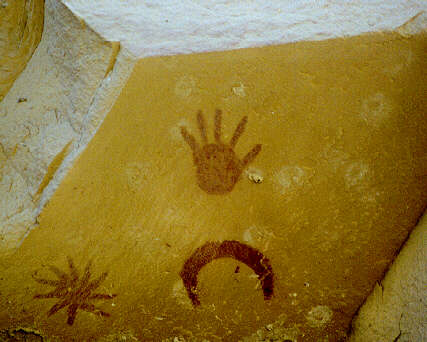
Whenever I have the opportunity to visit a Native American petroglyph site, such as the Anasazi one above in Chaco Canyon, New Mexico, I feel I am touching on sacred ground. I try to think what the meaning might be or was intended to be. I wonder at the one who created it and what they felt, what they hoped to accomplish through their symbols.

The Da Vinci Code mainly raised questions for people to consider. I did not see it as putting down the foundation of Christianity but suggesting people question what they know for themselves (in relationships, religion and anything else).

There was one element in the movie that was stronger, to me, than in the book. It has been a few years since I read the book; so maybe I am wrong. It explored how people can believe by punishing themselves for God, they are pleasing him and attaining spiritual perfection. Beat the body and you perfect the soul, prove the strength of your character, or atone for sin. This idea is in many spiritual traditions-- not just Christianity.

Incidentally, I was surprised to find I liked Tom Hanks in the lead role. After having read the book, I didn't see him as Robert Langdon, but the characters were mostly vehicles in both book and film for moving from one symbol to another. They were where events could unfold as well as be digested. With lots of fast-paced action, there was limited time for interaction between them.

The film left me wondering what personal symbols should I be more aware of? Am I walking around missing too much? I believe, we can all go through life on different levels of awareness from just living to what some call enlightened living. Although now and again things will nudge us or even give us a shove, in the end, it is our choice.

Wednesday, April 05, 2006

Leaving a Message


Each people in their own way
try to leave behind their story.
Sometimes in words--
oral or written.
Sometimes in pictures.

When I see symbols painted
or etched on rock,
I always wonder,
Who stood here before me
chipping at this stone?

What message did they leave?
Who did they expect would see it?
Did a spiritual leader do this while
others prayed or danced?
Was it a secret ritual?
A ceremony by a shaman?
Or an artist depicting their world?

Though their descendents might say
Oh yes, I know what that meant
Do they?
For me, I only know there is a spirit here
as there are in all such places.
Here, one human speaks to another
and across the ages we touch.

I shot my first deer today by the river. Thank you, spirit of the deer, for giving up your body so we may live
Thank you, Great Spirit, for this blessing.


Oh yes, a story is always worth a moment
of our time to consider
as even today we leave our marks.

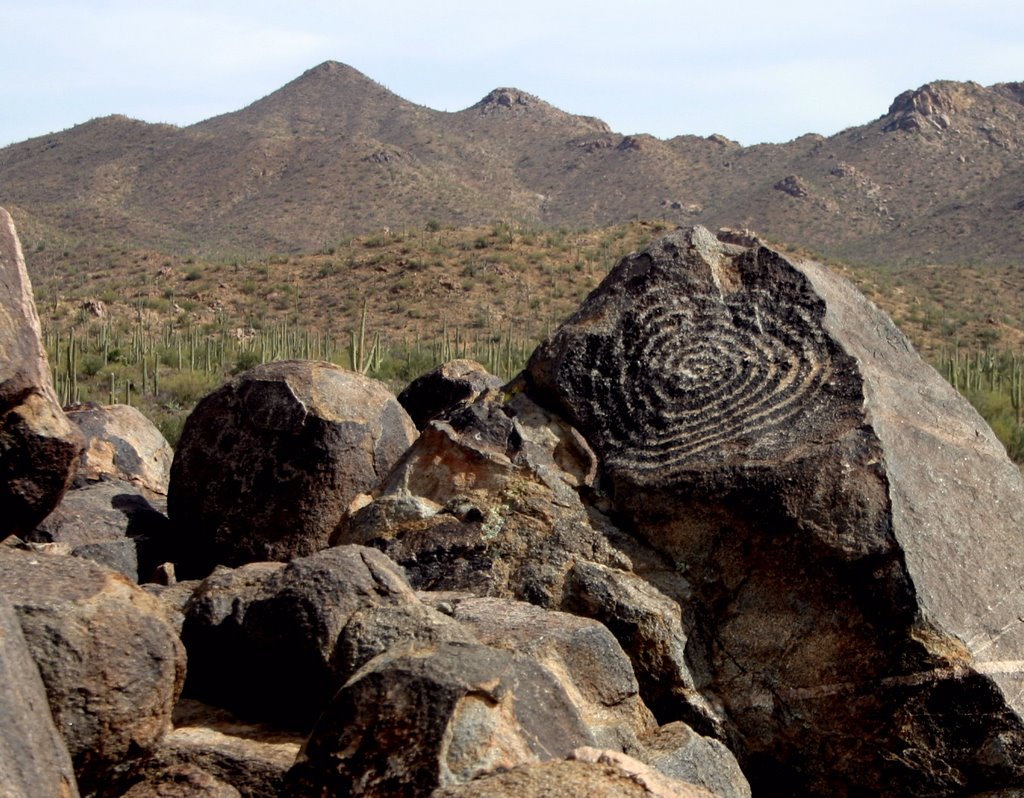
(These petroglyphs from Signal Hill and Painted Rocks were likely done by the Hohokam people perhaps 700 or so years ago.

The sculptures are part of a series for repeating the steps of Jesus at Painted Rocks Retreat Center directly across the wash from petroglyphs.)