Comments, relating to the topic, are welcome, add a great deal to a blog, but must be in English, with no profanity, hate-filled insults, or links (unless pre-approved) To contact me with questions: rainnnn7@hotmail.com.


Wednesday, August 29, 2018

Questioning painting myth # 1

Myth # 1
Stop before you make mud and ruin it.


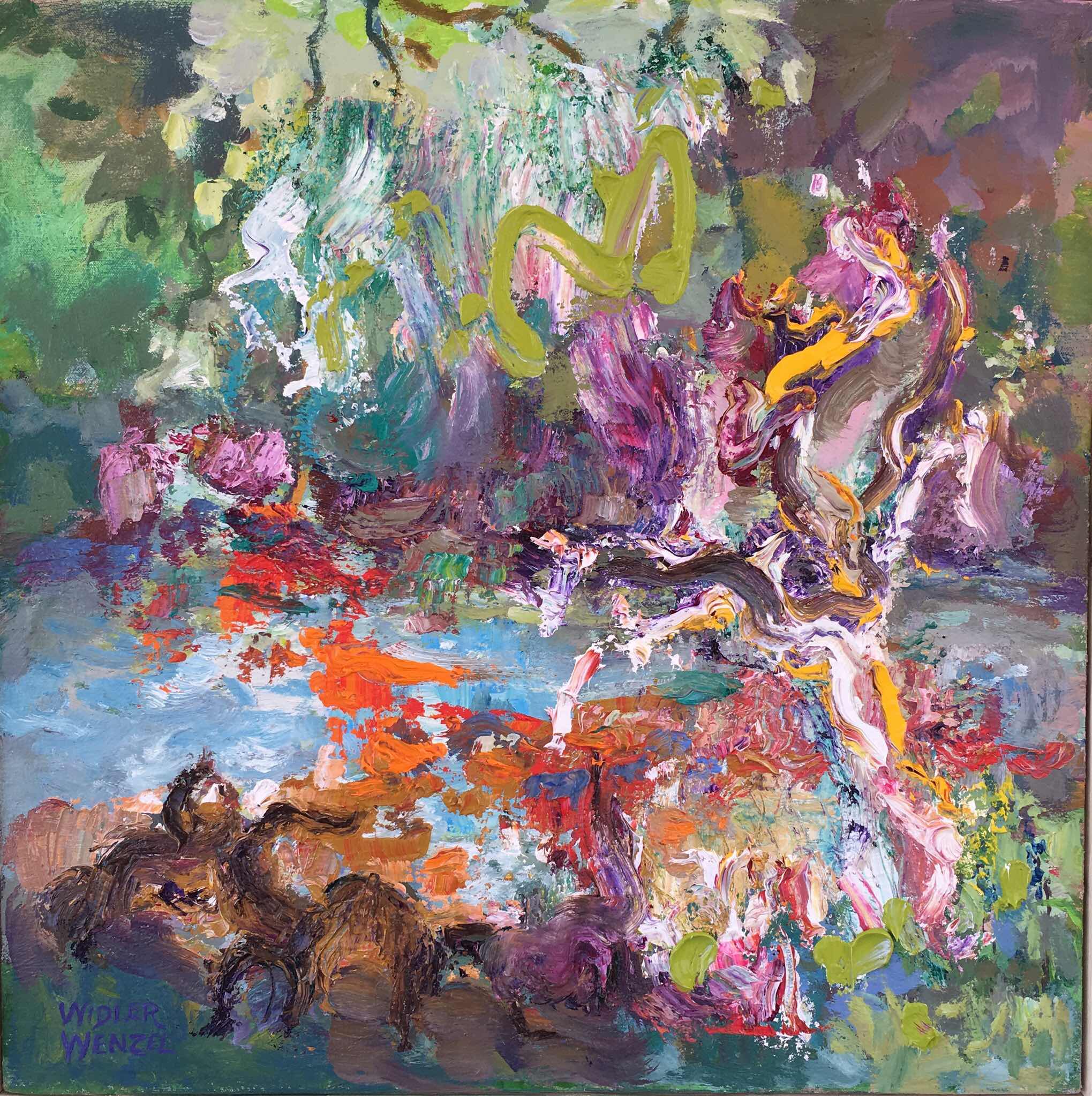
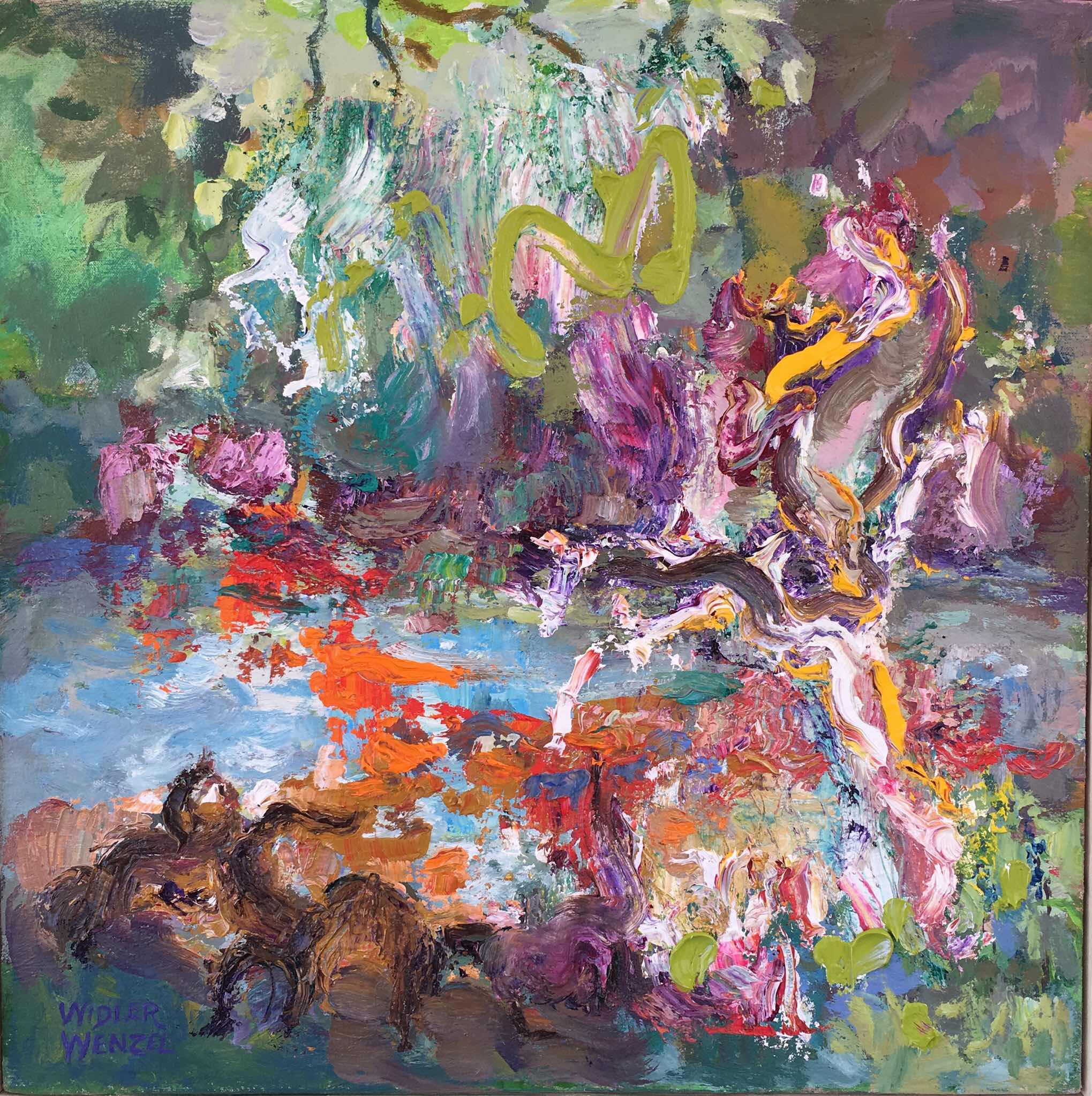
At first I thought this was done.  Then I wanted to shorten the tree to make room for the tree to reach for sky making more impact. So I kept working. Once I made one change I saw more to be done.  I may never recover the spontaneous flowing movement. But I continued because I wanted the low relief of the thicker paint  to read. as a tree.  The sweeping branch was not a path to the far distance but a branch I wanted to sweep towards the viewer. The branch  needed to be thicker than the sky behind it.  I felt the movement was too tumultuous. It needed the stability of a horizon line.


I have achieved a horizon line. The impasto texture reads better. The curling branch has as much impasto as the sky behind it. So I signed it but I felt the signature is premature.


The wisdom here, contrary to the don't overwork a painting myth, is to bravely continue to develop your notions.  The last linear mark was fresh, straight from a yellow ochre tube swirled onto the right corner to balance the sweeping lower branch on the left side. In this case the last gestural line is not a decoration added to the tree but an essential part of the mood and life movement focused on my feel for a struggling tree with limbs stretching to the sky.

Saturday, August 25, 2018

Places that inspire a story

by Rain Trueax

When writing fiction, why is it set where it is? Some authors create places. I prefer placing mine in real towns and landscapes. Sometimes where that is will be influenced by the problems the characters will be facing. Because I know them best, Oregon, Arizona and Montana end up in most of my books.


In my books, of course, there's a love story but with complications. When I know the problem, the reason I am interested in writing the story, next comes its setting. I need to know where my characters live, their homes.

To give where these people live, I found some images from my own photos and others I'd purchased. Naturally, their homes are only part of the environment as they move around. Sometimes I only know where they'll roam once I start writing. That's the fun of writing, the discoveries I make along with them.

Thursday, August 23, 2018

How often does a painter have to paint to be an artist.

Since I posted yesterday on when could I rightfully identify myself as an artist, I realized that I didn’t include my thoughts on how often I practice painting in order to feel I am an artist. When I had two small children, I did not consider myself an artist then. I entered competitions as a non-professional. I was harder on myself than I would be now.  Motherhood is a supreme creative privilege and the most awakening to the heart.

 Choices have to be made to make time to paint. Learning to make priorities and say no to many activities that distract. I have difficulty saying no to co-operative galleries, no to daily painter web-sites which exhaust me while trying to achieve every day and prevent some risk taking.
In progress

Painting almost every day makes for my best results but not necessary for being an artist.  More important is how often during every day a vision of a painting crosses the mind. Also how many ideas are incubating. 
Another important aspect of being an artist is being able to access their own work’s direction towards self satisfaction or  the market place. Some periods during my many years of painting I have been more concerned about selling than other times. Always felt I was an artist though marketing could have smothered my desire to try new subjects and directions. For me repeating the same old same made me feel less of an artist but some artist traditions thrive on repetition.


Wednesday, August 22, 2018

Limited to brilliant masters or all of us are artistst?


In general an artist is defined as someone recognized as the maker of art. OK? Well no!!! Several problems occur to me in this definition. This definition infers art is a tangible product. What about performing arts like music and story telling, and  humor? Second, the maker must be a publicly known.  This definition does not include people who identify themselves as artists but do not show what they do. Is it enough for an an individual to identify himself as an artist or should others  bestow the title upon them?

When I was a child my art work was recognized by my parents, teachers and peers. Except for an exception when a high school teacher thought I was not good enough to pursue art and I should take home economics instead of art classes.

Currently I identify myself as an artist because this creative practice laps over into all aspects of my being. As a maker of paintings, my experience of life is enhanced with the joy of seeing, hearing, tasting, and touching. Creative problem solving is useful in how I see relationships and determine such things as choices in spending money. I like shopping for art supplies better than shopping for clothes.
 I view my paint palette like a kid in a candy store.  I hear the beat of the brush on canvas or board. The rhythmic sound tickles my movements dancing across the surface. Like a kid I like new toys - the cake icing spatula. It's twang when applying buttery oil colors makes me feel jazzy so I add a little secondary surprise.
 
So when did these simple joys begin?  Childhood! So there is an arguable case that I was always an artist. We all can have these simple joys if we practice. Humans are by nature curious and playful and happy when they are in awe and involved in something they love..
When I was about 10 at Christmas time, I was on a San Francisco childrens' program, Captain Fortune. The show began  focused on a group of children decorating a tree. I was very caring about how my ornament was to be placed.  I tried it in several places before settling on hanging it.  The camera man zoomed closer focusing on my hands. Even then I arranged things with loving care. Loving care makes us all artists. Love is important in making things by hand such as a painting or a ceramic pot because in most works there are uncertainties and problems which take love to resolve. Love is important in creative activities like cooking, arranging furniture or nurturing a garden. So all of us are creative and how much of an artist we are is to the extent that we put our heart into our doings.
Some media is considered a higher art form than others. Like oil painting is a greater art form than pastel painting. Landscape painting is a greater art form than book illustration. So an oil painter is more apt to be considered an artist than a pastel painter and a landscape painter can call himself an artist but not a book illustrator. Ridiculous, in my way of thinking!
 The question one of my peers proposed is: "Shouldn't there be a word for those practicing the art  that distinguishes their commitment to being highly skilled and expressive beyond the norm?" By those standards only the most outstanding and most historically influential should be given the title.  If not just plain artist but something like "practicing artist" or "master artist"?
This is my own opinion of what it is to be an artist but I know there is much difference of opinion and other valid takes on what it takes to be an artist.
 

Saturday, August 18, 2018

It's the setting

by Rain Trueax


My idea for the blog that led to so much trouble was reading something another author had written about the importance of not forgetting to talk about and advertise backlists. If a writer has been at it long, they likely have some kind of backlist-- most of which has fallen into Amazon's black hole. Their ranking algorithms favor the most recently published books. 


Mostly (with two exceptions), my backlist is made up of contemporary romances written from the 1970s through the early 1990s. For those years, they were what I most enjoyed writing and reading. I liked having characters deal with today's problems but still have the mythology of those who take care of problems and build things-- the pioneer and cowboy ethos.

Wednesday, August 15, 2018

Photographic aids for establishing a point of view for painting


These pictures were taken with my I phone holding it way above my eye level in the one with sunflowers and sprinkler.


I held the camera below my eye level to take the selfie of me in the blackberries.


The camera lens finder or binoculars are tools useful for inspiration to paint.. When painting on location I have used both to help me select from too many stimulating subjects outdoors.  These four photographs are examples of taking a pictures with the camera tilted  upwards like the point of view of a child. I like to keep  the innocent child-like excitement in my painting and the perspective has something to do with the drama and charm in my painting.

Saturday, August 11, 2018

Using a Mistake

by Rain Trueax 


You have written all morning putting together a blog. It's gone along well. The words flowed from the original idea. You hit a key, and suddenly all you see is a blank page with the letters lk. You panic and think-- hit the reload current page symbol at the top of the page, hoping that will mean the one you had before the apocalypse happened. lk stares you in the face. You just made your second mistake. 

That was the fate of the originally planned Saturday's blog.

When something like that happens, I always wonder if what I had planned was a mistake. I considered that but decided it had been a good idea. Maybe though there was a better way to proceed.

I took my idea to Word, where autosave doesn't happen. Before beginning, I was curious. Might 'lk' have meaning? It turns out to be an internet shortcut for like. Was my computer having fun with me? Are they often having fun with us and sometimes maliciously? 

One of the movies we watched last week, due to our grandson being here, was inspired by a Stephen King story, where the machines turn on humans due to a comet having passed. Could it be sometimes our computer/internet does the same-- without needing help from a comet (although, a comet did pass pretty close at that time)? 

 More likely, it was just typing too fast and hitting the dreaded, short-cut keys-- two of them though??? Anyway, onward and upward as a friend of mine used to say.

Thursday, August 09, 2018

Examples of fantasy cloud paintings


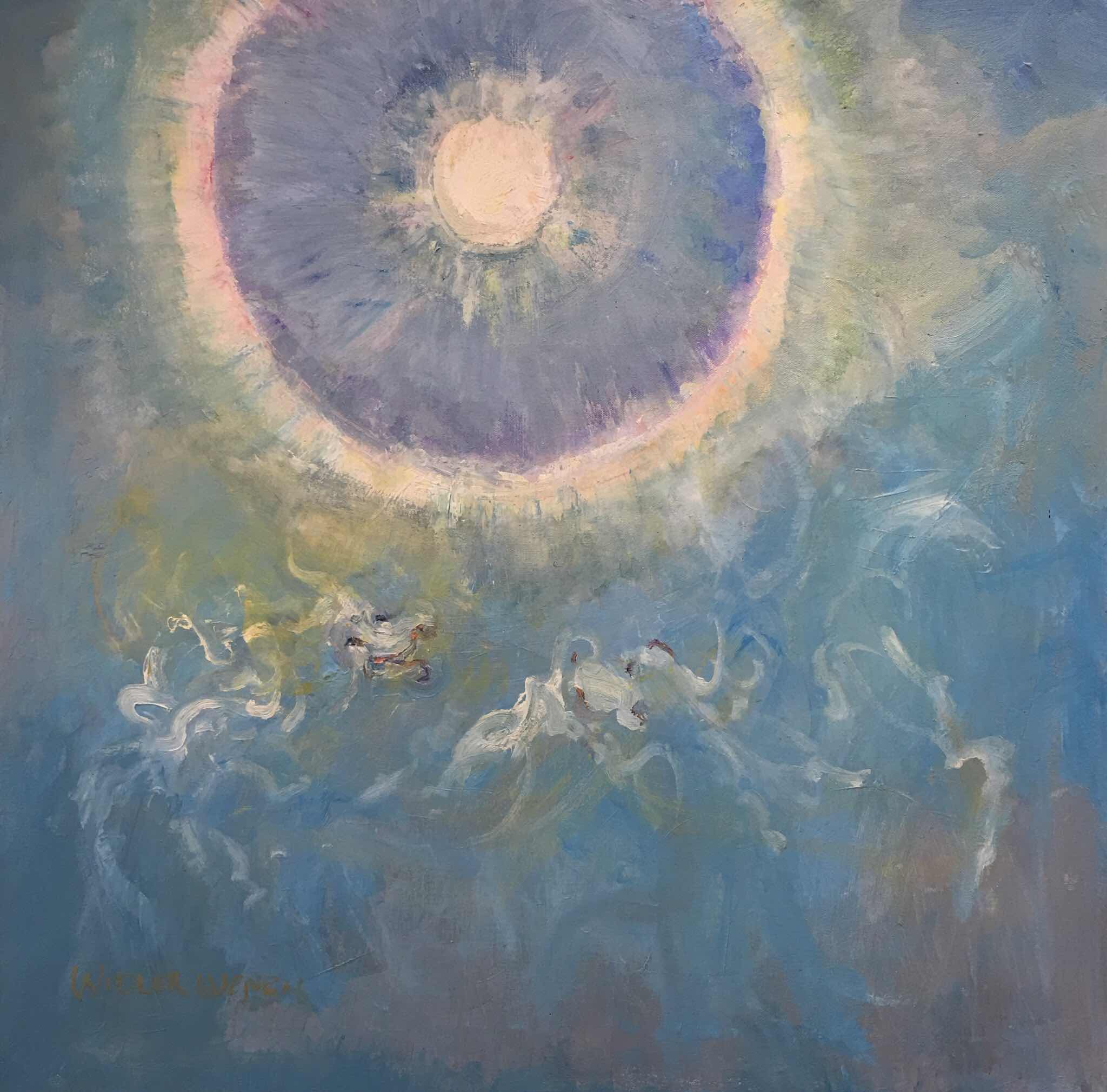
Yesterday's blog post featured photographs of clouds with fantasy titles that are inspiration for when I am on location and am moved to make a fantasy painting. These paintings are done on location during a period when I was seeing dragons in the landscape and clouds.

Wednesday, August 08, 2018

Silver lining clouds as inspiration for painting

  Thank you grandson Kevin Oliver for sharing your interesting photograph.

"Every cloud has a silver lining' is a saying of hopefulness symbolizing that life's dark clouds will pass. I have always fantasized that the expression "Silver lining" referred to clouds as being clothing to cover the landscape with a silver fabric lining. My imagination could picture clouds blown out into silken threads as they continue to be spun to cover the sky. Fantasizing clouds as recognizable things like dragons or fish is a pastime I have enjoyed since childhood.

My eyes are always surveying the sky for interesting clouds. When I see some that have striking qualities, I try to capture the ephemeral clouds with my I phone.

Pearlessence of sea shells

Freckled flight

Golden cauliflower

Grosgrain ribbons

Petticoat mist


Al these photographs are finished pieces which I do not plan to copy in a painting. For now I acknowledge them as a way to familiarize myself with them. Even think about how I would paint clouds like them so when I am in the landscape and I see a passing formation, I remember how I could paint similar clouds. I will already have fanciful titles to inspire me as well.
Platoon of Casper ghosts


Saturday, August 04, 2018

not as I expected

This has been a week where nothing went as I expected. I had written a blog for today and then because of other circumstances, it's not a good fit. I'll be next Saturday. 

With grandson here this week, my mind isn't operating on full cylinders, and today seems like a good day for photos. These are from our farm and this summer. It seems hard to believe it's more than halfway gone. Since out here, we all need rain, that's not a bad thing.


Wednesday, August 01, 2018

Part 2: Storing my ever growing output of paintings in a 1,200 square foot house


There is a limit to how many paintings can be stored in a 1,200 square foot house. My husband and I need room to move about and live so I am OK with  limited storage. Limiting the number of works requires retiring some of my paintings every time I make a new painting. I am forced to try to strengthen my entire body of work by keeping only my more interesting paintings.  I keep representative pieces. The pieces  that do not make the grade become table coverings, rugs, cloth books for children, or pillows.

While some artist friends manage by moving displays between galleries to other alternative spaces monthly, I keep that activity minimal to give me the maximum time to paint.   I also have work on loan like the Mennonite Corvallis Caring Place rotated every 6 months.  I donate or  loan works to The Oregon State Fall Creek Fish Hatchery and Research Center.

I spend more time thinking of what I can live without in everything from clothes to cookware and books. For years I donate the accumulated stuff from living in a product marketing economy.  Mostly I give to Habitat for Humanity, St. Vincent de Paul,  and Goodwill. When my parents moved from Washington to California, I took a whole trailer full of paintings and furniture, stopping at Goodwill, I donated a few 4' x 6'  paintings one of which was awarded best in the show in a Blaine, Washington Art Show.


After the donations I've ended up with closets devoted to sentimental family pictures and objects passed down to me and collected over the years.  These treasures are in boxes designated for my daughters and grandchildren. Sometimes they are ready to take what they agree is precious and sometimes I keep a few items until my children are settled.

Every time  I donate items like manual typewriters or one of my old fashioned meat grinders. Or family heirlooms are given to a family member who promises to be a  steward of our past. When I have gained a little more space for Don and I to expand I feel good.


 In an effort not to overfill my limited storage, I reinvent some of my paintings. Last Thursday's post about my least interesting Ritner Creek painting underwent an addition of radical reds that made the whole rest of the painting less precious.  I soon became immersed in new avenues to explore.


My new journey is about the tree that died since I completed the original painting last year. This year the flow of the creek is slower. The  very shallow water is warmer. Some  of these steps in the change could be called finished but I am open to more experience.


A number of different near solutions help me learn what linear quality will slow down the flow of the creek. What lines in the tree will be most expressive of struggle?   Stay tuned for a possible resolution. Not sure it will be a keeper.The risk is worth all the learning on how the linear changes effect expressiveness.

More ideas are covered in previous posts can be seen by looking over my previous posts by clicking on my name under labels.

Saturday, July 28, 2018

book covers

 by Rain Trueax

At one time to buy a book required heading to a bookstore. For some, it still does. When browsing down the shelves, what you see are mostly splines. The author's name and a title either attract or you go on. Only when you draw out the book do you see the cover. The cover isn't the reason you pull that book out but seeing it might be why you read the back cover and a bit of text. In bookstores, covers might matter to readers; but they are not the initial draw. They are not the hook.

Today, many of us get our books online. As we skim along or maybe get an email encouraging us to purchase, usually, the first thing we see is the cover with its title. It then is very important as a turn on or off (maybe less so in non-fiction). The business of covers changed with eBooks and the addition of writers, who were not in corporations, where the choice of covers was given to "professionals".

Thursday, July 26, 2018

Part 1: What I do with my prolific accumulation of paintings


In this post and next Wednesday's post I will be giving examples of how I manage my collection of my own art while remaining prolific and not promoting sales.  Not magic!!

Example 1: Further development of a finished piece.

Of all my Ritner Creek paintings this one started in 2017 was the least exciting.


A young tree died over the winter so I entertained the idea of painting the essence of the tree’s death struggle. To activate the energy I swiped discarded credit cards with red and brown paint to symbolize the warming, more shallow water.


Paint straight from the tube,  has made the painting more disturbing than after my first swipes. The patio painting area by 9:00 AM was too hot. Tomorrow I will decide how to proceed. Next week I hope I can publish the resolution of the "Death Struggles of a Ritner Creek Tree."  I will also explain how I came to think less about individual pieces and each piece as a part of a body of work enabling me to make decisions on what is representative and worthy of sharing. I treat my art like garden plants, after they have been seen sometimes I prune by finding new uses for old work.

Wednesday, July 25, 2018

Resolving Ritner Creek painting; my stategy to keep the life energy of my first impression

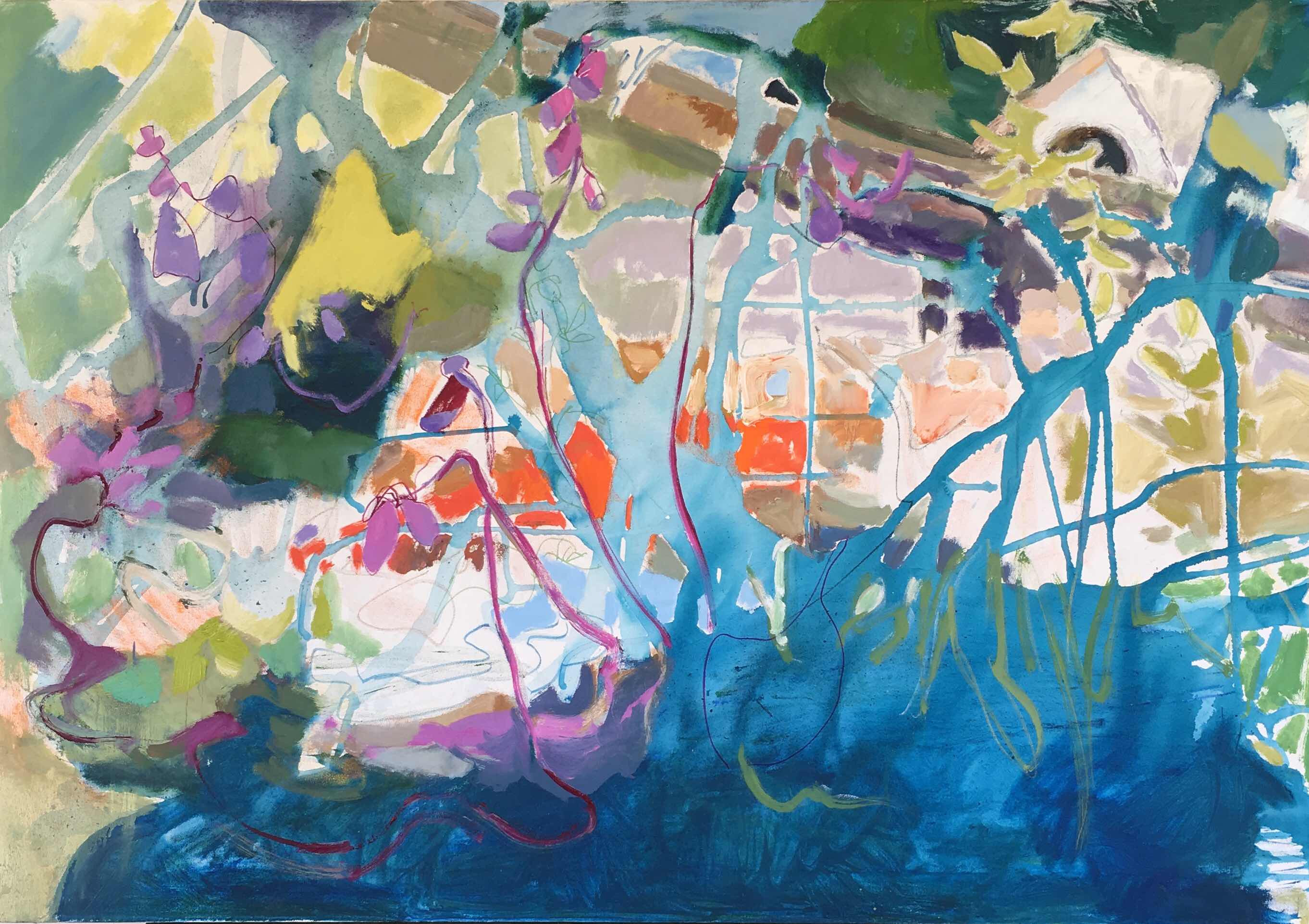
24" x 16"


40"x 60"


My 1960 abstract had dominate blue lines in front of firey color similar to my Ritner Creek painting.                   


Early in developing Ritner Creek painting I enjoyed a journey without a formula or procedure other than working all over the surface. Mostly invented with happy abandon, I proceeded. But as I neared covering all 40 by 60 inches, I was unsure of my final steps. Usually I would sketch linear diagrams. I didn't need to because I remembered I had painted a picture with some similarities.

I had been working with little self-critiquing between 8:00 AM and 10:00 AM for several weeks little by little the abstract took on color, texture and recognizable subjects. I dabbed paint in the spaces between the existing blue lines.  I was avoiding tightening up as I worked within the boundaries of the lines by dabbing the paint and not exactly filling the shape.

Stiff, forced shapes and line are lifeless.  In comparison to the rough shapes that were intended to be behind the branches the blue shrubbery started looked stiff so I applied thicker paint over the acrylic faster and faster with little attention to staying within the line. The blue paint overlapped the background on purpose. The paint was thicker than most of the background increasing the impression that the cool blues were in front of the warm oranges.

Both the early abstract and Ritner Creek paintings contain features from nature. The abstract has cloud shapes and warm colors like fire. Unlike the early abstract the Ritner Creek has recognizeable nature and architecture arranged  in a natural sequence of foreground, middle ground and background as seen in nature. Drawn perspective became important. In this painting I made a concession to realism marking symbolic lines of the path of the water. A realistic stream requires suggestions of where the river bank is.

Time to judge how busy I want the painting to be. Time to compare the lines with those in an older painting. All the existing lines are put in question. I wondered how much movement and how fast the movements can be and still have a the painting comfortable from a viewing distance within my home. Did the lines that formed acute angles look like the branch was broken? Did I want to create the impression that the hotter than usual July was devastating?  No!

I wanted an aging, stressed landscape that was beautifully striving to adjust and live.
The lines in my early abstract are controlled, sure and fresh. In the Ritner Creek painting the lines change direction and crisscross. These lines express another feeling and another narrative. I reviewed my initial intention on location.

Keeping my first impression from painting at Ritner Creek: 

Under the shadows of the huge oak trees a cool tangle of blue flora symbolically opposed the warm shallow water. I felt energized, young and awed. Not broken! So the zigzag forest green line had to go. Large color zones were joined to simplify and slow down the linear speed.

Another technical challenge has presented itself as I lightened some of the darks here and there dispersed throughout the painting attempting to simplify the color areas, the whites became more like pastel colors. Perhaps I should say tints instead of pastels. Pastel painting is now recognized as being equal to watercolor, acrylic and oil painting.

Yesterday, I felt some background areas were too precious to paint over them with more blue shrubbery. I turned the painting upside down and painted more thriving life into branches with curves more like my early abstract painting. Also shortened one vertical twig adding three other vertical twigs because vertical lines slow down the movement making it more comfortable for viewing in my small house.

The painting is not perfect. Small imperfections are life giving. I am calling it finished for now. I can't wait until the oil is dry enough to hang the painting up inside the house, then live with it until I see if it creates Ritner Creek atmosphere. I fear when I bring the painting indoors that the colors will look much darker. Also will the rough brush strokes be too busy for close viewing. Such are the questions I have as I consider cataract surgery. Maybe after surgery dark colors will be more vivid indoors. Or maybe cataracts are a bonus to my creative impressions.
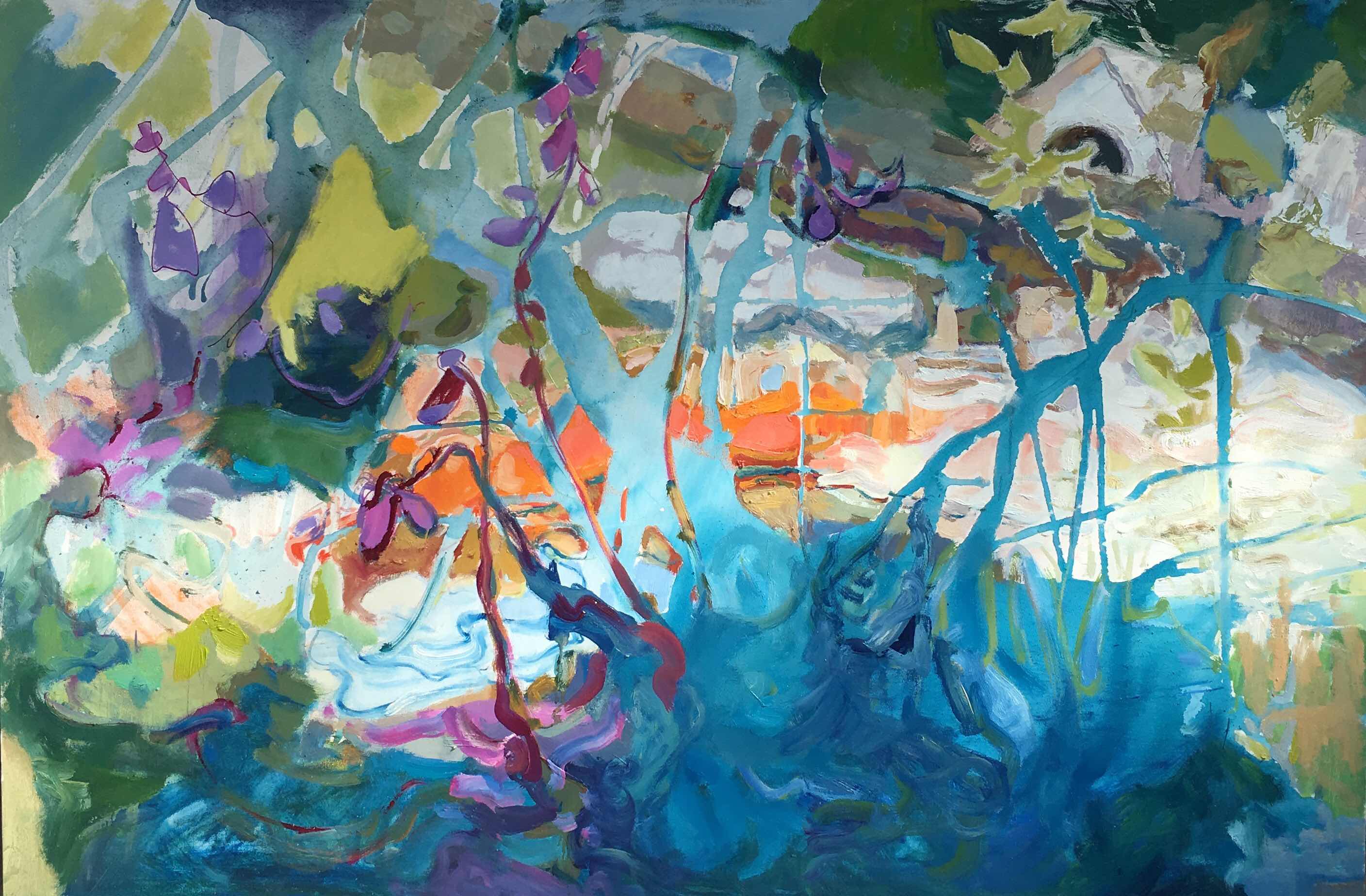
Midway
Finished, maybe


Saturday, July 21, 2018

ups and downs

by Rain Trueax


I am in a group blog, Sweethearts of the West, where I posted the blog below. It got seen by less than usual there as at the same time I learned that a writer friend, Celia Yeary, had died. I wanted to post on her loss, what she had meant to me and it kind of buried my blog where I wrote about the history of the Chinese in Oregon. I thought I'd share it here as I feel it is an important part of Oregon's history.

Wednesday, July 18, 2018

To paint or not to paint from a photograph?


During the hot days this summer my husband and I like to make road trips to the Oregon Coast.  When we make a stop, a favorite walk of ours is the Salishan Nature Trail. The daisys are in the parking lot of the Salishan Market Place and Spa.  The trail head almost hidden is in back of the market between the golf course and Siletz bay.


A great view for a picture is always had from the nature trail on a man made dike upon which the trail heads towards Gleneden Beach.  Costal pines frame the shallow bay. Many birds are often sighted. Very nice for painting, not. Many dog owners from the area walk their dog here and the trail is narrow and I do not want to remain on the trail when golfers are unable to control their balls.

The groomed golf course lawn is like a canvas for interesting shaped shadows. Even though the photos are interesting they do not compare with what I could imagine in paint. The darks in my digital photographs are flat dark. In the real world the dark areas contain  greater variety of color hues and relatively light areas.
I could just use the photos to remind me of the place and go home and paint from the photo and memory. I have done that but the number of possible pictures I see and photograph are a problem for me because I go around happily imaging paintings everywhere I look and I have only a few hours to paint and a few surfaces ready for paint.
As incomplete are my photos in comparison to what I might paint, I am happy to photograph what interests me as a fun thing to do as a completely different thing than my usual painting process.


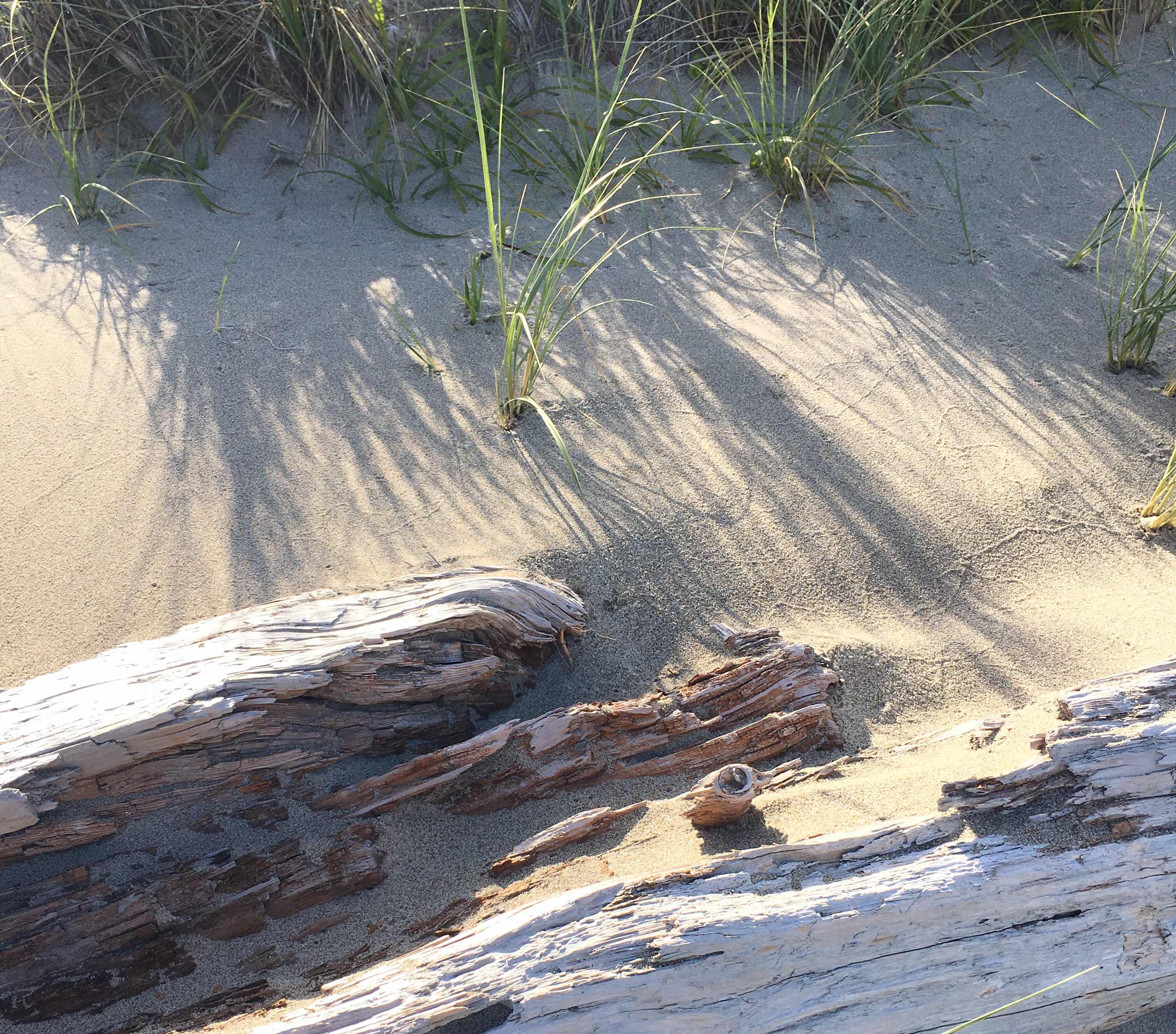
On the dunes of Salishan Ocean Beach I photographed more pictures that excited me. Maybe my peaked interest in lines recently caused me to select subjects that were strongly linear.


The photos of Salishan Gleneden Beach are finished and I have no desire to copy them in paint especially since on this walk I sketched. For awhile I found a log in the shade where I could sit and sketch. This sketch, if I should paint this from memory, contains a useful selection of color values from dark to light, textural patterns, and an interpretattion of movement that is all over the picture. It is an unfinished sketch and could be a guide to important pictorial considerations that  would not show up in a photograph because of either not enough definition in the dark areas or if the darks are visible the light areas would be too light.


 Photos  do not hold
enough of  what I care about.  I like experiencing the place and my own immediate emotional reaction.  I like to feel the energy of the place flow through my body as I draw.
 

Tuesday, July 17, 2018

Painting from location, then at home

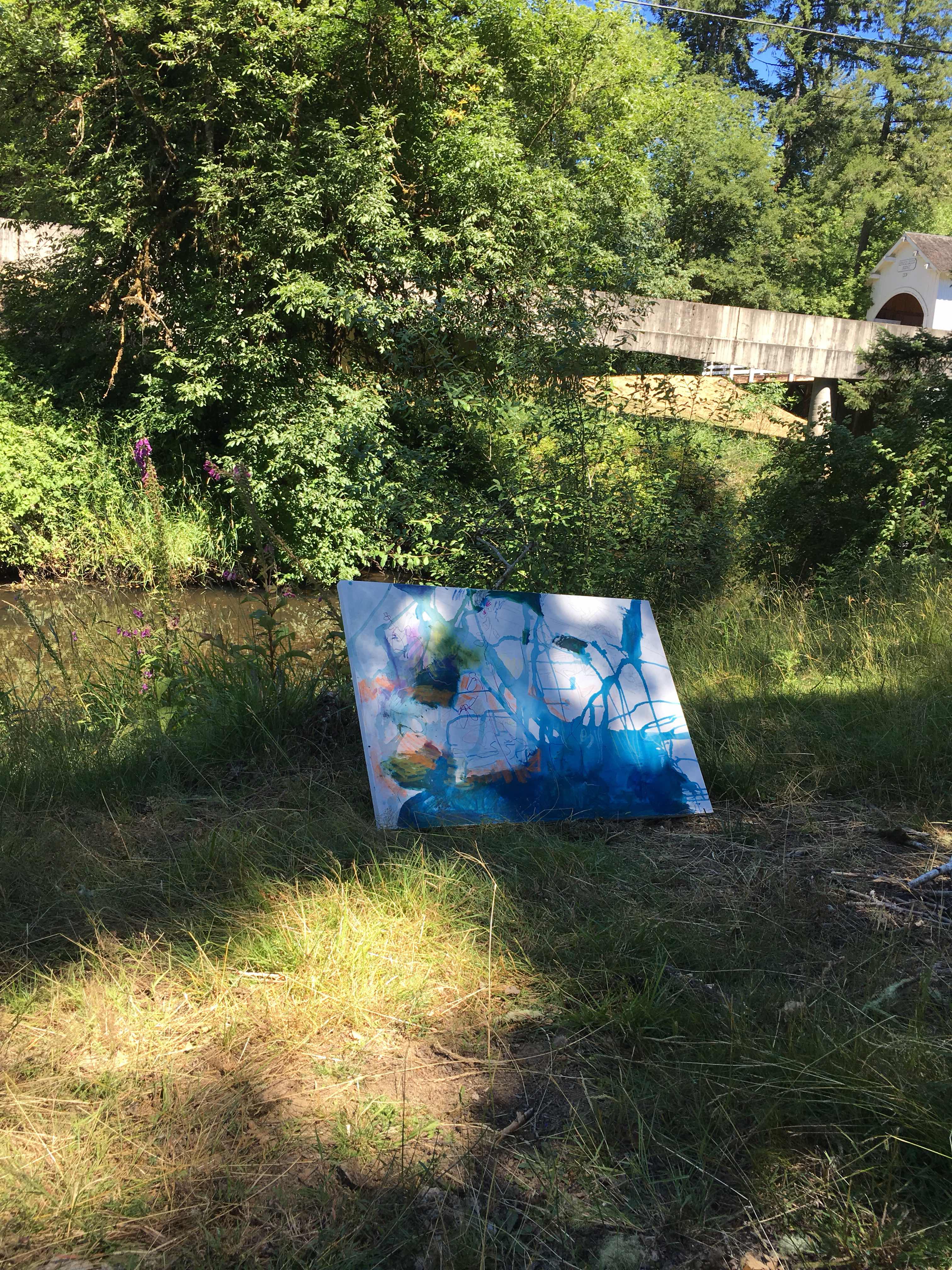
On my fourth day I still have not looked at my digital images of the location. But now I have reached a  turning point and tomorrow I will decide if this painting will undergo further abstraction or will I add children playing in the creek. Tomorrow on this blog will be more about the camera sas a tool in painting. Below: The progress on an oil painting on a 40" x 60" canvas.