Comments, relating to the topic, are welcome, add a great deal to a blog, but must be in English, with no profanity, hate-filled insults, or links (unless pre-approved) To contact me with questions: rainnnn7@hotmail.com.


Saturday, February 22, 2020

busy week

by Rain Trueax

(Oops, I thought I had made this blog live. Well it has been a busy week lol)

This is a busy week for me with my brother visiting for a week. I am so happy to have him. He and Ranch Boss have done more things together than with me as I am still having foot problems-- as well as being totally out of condition. It's been great for all three of us as we are pretty much compatible. Until this opportunity, I haven't been with him as much as I'd like as he lives in Portland and when in Oregon, we live about 90 miles away in the Oregon Coast Range.

At any rate the only thing really going on with me is time with him, great conversations, I might add, writing, and what I see is going on with politics. Oh, we have watched some great movies together. My favorite was Murphy's Romance, also set in Arizona.

The photos are one of the things that we've done with my brother (Casa Grande Ruins National Monument above) and the wildlife cam at our Tucson house. This one is set to look up from a small draw that is on our property. The building beyond is the end of our Tucson house where the shop and storage room are. It represents part of what we love about being here-- sharing this place with these denizens both are night and during the daytime.


We had a front view of the bobcat last month.


Wednesday, February 19, 2020

by Diane; 1966 PSC graduate connecting with today's Portland State University's Art + Design School


The stench of the San Francisco Bay at low tide, smog in Los Angeles, and racial tensions among classmates at Portola Junior High School used to be vivid memories when I entered Portland State College January 1962.   I found faculty  had concerns that reinforced mine.  There was Robert Colescott who also came from the San Francisco Bay Area, and Florence Saltzman who had lived in Los Angeles. The Dean of Social Work, Dr. Gordon Hearn had taught at the University of California, Berkeley just before coming to Portland. Probably there were others from big cities who could see that  Portland was on its way to becoming a metropolis.  So the administration and faculty were motivated in taking part in shaping the growth of the college open to and involved in the growth of the city.


       My Freshman year in college I did a preparatory drawing for a painting that humanized the concrete freeway with a man on a stairway between merging lanes onto the Steel Bridge. The selection of my subject was a repetition of similar images that I did at Woodrow Wilson High School in Portland. The earlier Berkeley, California's freeways were memories.  My Portland State experience built on some of my concerns from having lived in the San Francisco Bay Area. The summer of 1962 the oil painting hung in the gallery facing the administration office. I was happy to sell it to the wife of an Oregon Health Science student.  This of course did not please my painting Professor Fredrick Heidel who thought students needed to keep their college work to inform for years to come their development as artists.

        I graduated from Portland State College in 1966.   Then I continued to be constatntly aware of my college memories. My formative years continue to feed who I am today as an artist and citizen.  February 7, Kailin Mooney and Alli Cleasby of the PSU Foundation came to Albany to share the direction of Portland State University's Graduate School of  Art+Design.  I  was delighted to learn that Portland State University's holistic encouraginging interdepartmental connection are healthy and growing despite devastating cuts in governmental support.

     Portland State College Portland community outreach increased during the 1960's.  I was privileged to know the Art and Architecture Department Chair Professor Heidel, and the Social Work Graduate School Dean Dr. Gordon Hearn, as well as making the acquaintance of the Chemistry Department's Chair Dr. Johnson. And I had limited contact with other departments that were all unified by PSC President Brandford Millar.  I had the good fortune of meeting PSC President Brandford Millar on several occasions while being a student and after my graduation at a wedding of one of Dr. Gordon Hearn's daughters. At the reception my mother bragged to President Millar that since graduation a year ago, I was selling most of my paintings. He made a face of disgust.  He said he wouldn't be impressed unless I was selling pieces for thousands of dollars each. The college's purpose was not to produce marketable artisans.

      Being friends with the Dean of Social Work's family, I was invited to serve tea at informal gatherings of students and faculty.  I met Social Work graduate students.  I met a music and math student  who was a friend of the Hearn's son, both majoring in math. My memory is hazy about who among my acquaintances was concerned about the rituals around death and thought about how the process of grieving and public memorials could be made without it being a business for profit.

"Opening Heart"
 in which parts of the continuously
encompassing knot dissolved.
It is #5 in a series
 of mathematical  topology knots. 

On a personal level since graduation the thread of my Portland State College art education runs a circuitous route both through my painting process choices and my conduct as an artist / citizen.

     PSC and my mother's example instilled in me the feeling of responsibility to share my art in community service.  Currently  I have an exhibit at the Albany Public Library through February. Then in March and April l will be showing on the ground south hall of the Corvallis Caring Place Assisted Living.  "Opening Heart" will be in the Corvallis Art Guild exhibit with about 20 pieces.

    I also volunteer to teach watercolor once a year at the Oregon State Fall Creek Fish Hatchery and Research Center's Arts Festival.

  When I am painting, I often listen to what I think my painting instructors  said.  Fredrick Heidel said to make it easy to set up yourself to paint.  My latest series of topology knots, was not going well so I listened to my memory of professor Fredrich Heidel saying,  “If a painting is not resolved, a transparent glaze can pull the painting together.” Heidel was fond of Shiva Rose Red. The Shiva company went out of business so I substituted a little Quinacridone Red in mostly Liquitex Gloss Medium.


My sore wrists and shortage of time is aided
by using a recycled cookie container and empty glass
Yoplait Yogurt containers. Thank you Heidel and his wife Florence Saltzman for recommending easy set ups.


 A few years after graduating from Portland State College, the art department sent out questionnaires asking what our transition was like going from academia to making art out in the world. I sent a cartoon of me in hiking gear with a camera tripod topped by a drawing board. 

To sum up my Portland State College experience, I carry with me memories of  my instructors and fellow students at Portland State College.  The experience continues to inform my art and my curiosity. While visiting Denmark and Norway I photographed their use of light in architecture and lighting fixtures.  In Paris last year, I traced the foot path of Henri Rousseau to the hot house gardens where he drew inspiration for his painting "The Dream." The banner for this blog is a detail of a painting intended to be a present day version of Rousseau's painting.
 

Saturday, February 15, 2020

the day after Valentine's Day

by Rain Trueax


If I'd had a blog day for the 14th, I might've written about romantic love between people. What is it? Is it real? Does it last? etc. etc. But this is the day after the day devoted to romance (and buying cards, candy and flowers), and I don't have any specific subject in mind. 

Usually, I start thinking of blogs, sometimes weeks ahead of time, but this time, it was Tuesday and nothing had popped into my head. Then I saw this article. 


It's a very real prejudice that some would never read a romance novel, but they have no idea what is even in them-- since they never read one. OR they read one from years back, when as that writer suggests men had more to do with what made it into the novels than what evolved once writers took charge through indie publishing.  

Romance novels today vary for what they have in them. Some are virtually novels with complex problems for the characters to work through. I prefer them for my own reading. I like to write and read a story where the main characters are working through something to which most of us can relate. Sure the romance is fun and at the heart of the story; but if that's all it is, it becomes boring to me.

Why can't a romance novel inspire us to deal with issues we also face, as well as entertain? Isn't it nice to have a story where we know the ending will be happy? When it's historical, it can reveal what life was like in a bygone era. When it's contemporary, it can have emotional issues where we can relate-- even if they are not ours. 

There are romance novels where the story is all about the romance for those who need that moment of escape. Fortunately, today, there is room for more complex stories where there are readers who like that too.

Wednesday, February 12, 2020

by Diane: A visit with both PSU Foundation Associate Director of Development and PSU Arts Development Coordinator

1962 during summer vacation
Friday, February 7, I shared a few of  my memories of the Portland State College's Art Department in the 1960's with Portland State University's Foundation's Kailin Mooney and Ally.  Then they told me about the developing School of Art + Design graduate program.

    I believe for over 55 years there is a strong thread of continuity.


To the left is Issac Allen
Soon after he changed his name to Issac NoMo because his real name and roots were wiped out by slavery. He has come to identify himself as Isaka Shamsud-Din, artist, educator, Black Muslim and activist. His on line resume connects him with the King School Museum of Contemporary Art. The  student run museum brings national artists to the school for student workshops. The museum serves economically under priveledged students who would otherwise have no art exposure.
      In 1963 I felt uncomfortable being the only student being photographed, so I invited Issac to stand in a silly photograher's choreographed pose. Luckily never published in the Oregonian! Obviously not Issac's or my most comfortable moment!
In the photograph to Issac's left are me in the middle and my mother Margaret Widler.
       The photographic session and interview was by The Oregonian newspaper to promote a student sale to benefit art scholarships. The idea of having a student sale to fund student scholarship was  mother's idea.  As president of the Mother's Club she brought about and organized the event for several years.  She was sharing her art entrepreneurship that went way back before she worked her way through college during the depression at the University of California, Berkeley. This was her way of supporting me! She had the best intentions of sharing her enthusiasm for art education: The results were mostly good.
     Being photographed for a featured article in the Oregonian made me giddy.  Not Issac!  Issac also had identity issues searching for who he was.  The art market to him was dominated by white culture, he was unsure if he could survive as an artist because he was black. He was not excited by the student sale.
         Issac already had a mission in life to document his experiences as a West Coast black man and a survivor of the Vanport flood that had destroyed Portland's African American neighborhood. He was a few years older and far more mature than I was.  I remember the figure paintings he did under the instruction of Robert Colescott. Issac was painting the African American experience before his instructor embraced his identity and expressed it. But later after a trip to Egypt Colescott became a renown African American painter who depicted the hypocracy of African American sterrotypes.
       The sale of my painting at the student scholarship sale boosted my ego. But Issac did not sell his heart felt, expressive painting about Vanport; he was very, very discouraged. Not even the sale of his ceramic pot to my mother was compensation.  His pot expressed his soul beaten and scarred on the exterior but soft warm melted chocolate on the inside. 
      After the sale Heidel spoke to our upper division painting class.  He tried to comfort Issac and others who did not sell. Heidel said that it makes no sense what sells and what doesn't. Sales have no bearing on the authenticity and value of our paintings. Heidel's intention was to make art vital to our life as artists and a vital positive force in the Portland community.  In other words PSC art curriculum was not trade school preparation to train us as producers of saleable paintings.
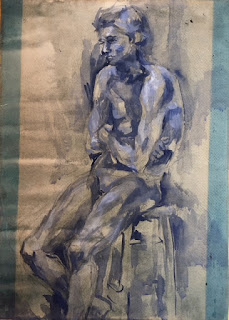
Completed in
Figure drawing and painting class
Instructor Richard Prasch
1964
If not the goal of instructing students on how to make saleable paintings for the art market, what was department head Heidel's vision for Portland State's Art Department and Portland?

        One precious part of my Portland State art studies was mentorship with artists who had a rich creative process. Frederick Heidel, Richard A. Muller, Richard Prasch did not demonstrate how they personally drew or painted. I didn't even go to galleries to see what their work looked like. They shared their process through assignments while allowing me to try different ways of putting down marks and paint where my intuitive voice seeped into my work. Heidel would gently steer me away from my own departures  made for shallow reasons.  He believed I had my own story worth expressing.
       My three mentors didn't have rules or techniques but posted examples of masters of painting from history.  As I was leaving Oregon after finishing at PSC, Heidel told me that he hoped he had not damaged my intuitiveness. I was an intuitive painter when i didn't know what that meant. He said do not make academic paintings. Do not make studies.  Make every painting yours. Do not sell your work because you will need it as references as you develop. Have a rich art development.
      My development in art is now richly satisfying to me despite having sold important pieces. In some cases I arrange to get them back. As I have selectively adopted values of the PSU faculty to my life, my creativity expands to approach life's challenges.
       I thank my mother and faculty at PSC. Basic Design instructor Jean Kendall Glazer asked us to trace our path on how we move through our kitchen. I have expanded her ideas to how I move through life as being an artistic choice. My thinking has evolved to considering my values. And beyond to the opinion that we live in an art creative desert. Creating art is a basic human need. If everyone felt empowered to express their intuitiveness through the arts, the world would be more paeceful. Jealousy, greed, and violance would fade away. 
     
November 22, 1963,  I remember Professor Richard Muller deeply shaken when he arrived late to our art history class. He announced the shocking news that President Kennedy was shot and most likely dead.  He feared  his optomistic hopes were destroyed for an enlightened future for our country. He was worried that the support of education and especially art education had just received a death blow.
         Optimism had been high.  Portland State College had its first graduate school - the School of Social Work headed by Dean Dr. Gordon Hearn as well as an idealistic Art and Architecture department headed by Professor Frederick Heidel. Optomism soared with the presidency of Robert F. Kennedy's support for education and the arts. PSC President Branford Millar declared that we are Portland State College now but soon to be Portland State University. Our belief in our exceptional goodness in the United States was cracked by the assasination of President Kennedy.

Never the less the hope continued.
         The day President Kennedy was shot Professor Muller returned our term papers on the topic - a record of involvement in a piece of art. I believe a few days later in the next class session some of us were invited to participate in what Muller thought would be an important bridge to us becoming art citizens in our life beyond our college experience - a student run gallery. Six of us including Issac Allen and a psychology major started The White Gallery. A mission statement was our first task. Next weeks blog will be more about Muller's project that relates to the thread that continues today. 


Saturday, February 08, 2020

intolerances-- to food

by Rain Trueax


This is going to be a fairly short blog as I've had an 'under the weather' week. How did this come about you might ask or prefer not to know. For the prefer not to know, do not hit the read more button. 

Wednesday, February 05, 2020

by Diane: Update #4, Care Giver's Art Escape

The past week had my mind spinning, running about from one doctor to another with tests in between.  Then in addition Monday at noon my husband accepted an opening for an overnight fitting for a C-pap machine. He slept through the night which was phenomenal for him. But now we have to wait until the end of February for the results. Unless there is another opening!
       To my relief the painting palettes and found stamps proved to be exactly right for my life. One of the circles is made with the cardboard protection for a spark plug that a neighbor helped to install in our Toyota pickup. At the worst time the truck's transmission went belly up. Through all the distractions, my painting experience was better than I expected: I could paint a little every day for at least a few minutes.
        I like the linear quality of knots that I discovered in a math course about topology, a branch of geometry. Professor Satyan L. Devadoss' THE SHAPE OF NATURE is a video course from The Great Courses designed for not only people engaged in math but also for history buffs and even artists. I am amazed that I am getting a rudimentary understanding of my father's math hobby. I  am comforted feeling closer to him.  I have his wisdom in how he took such good care of my mother.


Saturday, February 01, 2020

Imbolc

by Rain Trueax


For those of us who celebrate a Celtic year, Imbolc (in the Northern Hemisphere from February 1-to the evening of Feb. 2) is the true beginning of spring (It didn't occur to me until last year that it would be celebrated August 1st or 2nd in the Southern Hemisphere as it is a seasonal holiday). It is midway between the Winter Solstice and spring equinox. 

Where I live, it marks the beginning of lambing season although our son, who looks after the livestock while we are in Arizona, had the first lambs weeks ago. Imbolc (you do not pronounce the b) means ewe's milk. Whether on a farm or not, this is the time of stirrings of new life, what might be called the quickening when life comes back from where it's been dormant.

Wednesday, January 29, 2020

by Diane: Update #4, Inspirations incubating

Thank you Rain for putting up a detail of my painting, "Fantasy" as the blog header.   It is a female strong 2019 fantasy interpretation of Henri Rousseau's "The Dream".  It is still a painting in process. Missing is a monkey and tropical birds hiding in the tree. This change will not change this header.

Playing more with knots to plan the second in series.


 Sunday I anticipated some days this week would be so challenging that actual hands on involvement, even for a few minutes, would not be possible. When this post is published, my husband and I will hopefully be learning how he can heal after no improvement from the hiatal hernia repair 12 weeks ago.
Bok Choy
I love vegetables and fixing them.  I spend hours cooking for me and my husband, so as I cook I am preparing to paint. I continue to seek forms that speak to me.
Purple Cabbage
Some of the waste is just too precious to eat.
Last year we couldn't get the bok choy to grow. Maybe the heart will grow better than seeds so loved by the purple finch we invite into our yard by feeding them sunflower seeds.  Maybe these beauties will inspire new work.
                              
 
 Maybe the purple cabbage will be part of an assembliage. I have many ideas. Too many ideas are better than none. Maybe I can tie them together soon.


Saturday, January 25, 2020

Ever as Before

by Rain Trueax


Looking for a new read that is a kind of magical realism just in time for Imbolc? How about throwing in a threat of the living dead? A particularly determined demon? Natural born witches, gnomes, warlocks, shamans-- this is, after all the 7th in the Mystic Shadows series of books that move beyond what we consider reality to something else. Might that something else be quantum physics? What if there is an alchemist aspect to how evil can be fought and contained? Imbolc is a good time for a story that is a mix of physical reality and romantic fantasy.

Wednesday, January 22, 2020

by Diane; Update #3 How my changes in the studio and palettes make painting more relaxing during stressful times

The past three weeks after hanging 34 paintings at the Albany Publc Library, I have worked to make a space conducive to enjoying painting when I have limited small segments of time. I want to also be there for my husband whose hiatal hernia surgery eleven weeks ago has failed to relieve most of his symptoms. Currently there are many tests underway.  He is in good spirits.
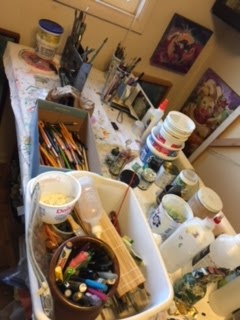
          First, I cleared the clutter.  Too many tools! Nice to have them shelved in our shop.
          Second, I have several palette designs for testing. They each have limited colors. My palette keeps the acrylic paint soft without having to twist off caps and prepare the colors every time I paint.
          Third, for the sake of relaxation, I  reduced the necessity of making complex choices in the process of painting.  I choose only one painting tool on the second painting - the back end of a foam bullet found on one of our neighborhood streets.  
           To be worked out  for the next painting: how to find the most expressive handeling of the bullet.
            Fourth, best of all, I did not need to clean brushes. Too often in the past I left brushes with acrylic paint drying and sticking to the hair.
 

Plastic clam shell from the bakery accommodates 3 jars 
left over from Yoplait's Oui yogurt.

Also fitting into the clam shell are fruit cups, small Tupperware,
and of course one pint size paint jar.
The clam shell is easy to close when I need to instantly drop painting.
to be helpful to my husband.


  The canvas board of the first painting was too textured
 for crisp stamped marks.
 I saved the painting by increasing the punch of  yellow and red.
I reverted from my goal and returned to my old ways of resolving paintings.
In the second painting, "Three Color Ability of Knots", I achieved a more relaxing painting time.
On the second one
The second, lower right is on
unfinished wood.


Saturday, January 18, 2020

Not part of the plan

by Rain Trueax


Well, that last hero was pretty normal-- if being a billionaire is normal. How about a hero who has some unusual habits-- like shifting into an animal? A rock star who wants out of that life? A man with a love that he left due to his frightening secrets? What if his deceased mother was Navajo and that land is still in his blood? What if he has an enemy out to destroy him? Hey, why not!

Wednesday, January 15, 2020

by Diane: Update #2 - Getting started painting


I am going about managing my paints like the Tibetan monk I met in 2002. Like the monk my  tools are made of materials in my easy reach. The monk's paint pots are an assortment of recycled containers. His brushes were handmade with stick handles. I am making a brush cleaner from what I can glean - plastic jar and void credit card.
We are using different paint. Mine is acrylic and cannot be reconstituted after drying like his. So I need to keep the paint moist in a sealed container.


The off white plastic clam shell take out containers 
are from China Delight Restaurant in Corvallis.
Balanced on the partitions are smaller plastic containers
gleaned from our recyclables. Two are the molded plastic
from Reach dental floss
and the larger ones in the middle are from hardware packaging.
The added small containers leave ample space below and above.
Below is space for a water reservoir to keep the humidity high
enough to keep the paint moist when the clam shell is closed. 
The dome shape above is spacious enough for sticks to remain in each color.
The plastic Daniel Smith paint jar was fitted with a paint brush scrapper cut out from a void credit card.
The small canvas board is where I am testing brushes sticks and stamps made of found objects.
 
In preliminary testing of a partially filled palette, I find I have some failures.
My scrapper failed. Thicker paint stuck to the credit card when theoretically I expected all paint to fall into the jar. Just pressure balanced the credit card when pushed to hard fell into the paint below.
Next week I will bend a stiff wire to stand high up in the paint scrapping jar.

                                
My start looks ugly to me so far. Will keep trying.
   

Saturday, January 11, 2020

It's Complicated

By Rain Trueax


What if? Do you know how many ideas for books begin with-- what if. The next thought can be-- ridiculous, but sometimes it's-- why not! 


Why not have a hero who is named after an ancestor who did evil during his lifetime? Why not have that man be the very soul who has lived lives between the evil one in an attempt to get his lives on a healthier course? How much of that outlaw violence would carry over into the one he's now living? Can someone really change their soul through the lives they choose? Since they won't remember those earlier lives, how much do they impact today's choices? What if he has spiritual helpers who have come along for the ride but that he doesn't see or want to hear?

These are the questions raised in Complicated Bargain-- third of the Hemstreet Witch books, now in a series called Mystic  Shadows.

Wednesday, January 08, 2020

by Diane: Update #1: My process in making a new painting goal

Clearing the way for an exciting new direction 

 is one of the best parts of exhibiting my paintings.


Studio before hanging my exhibit


Thirty paintings stacked against the wall

waited to be hung at Albany Public Library January 5 - February


Love seeing my work in a large space like the library! The spaciousness of the library gives me a different perspective in which to self-judge my direction!
With a good many of my paintings gone, I have room to clean and organize my work space. 
   For my quest to make a resolution  in addition to house cleaning, I watched the DVD Netflix documentary, "Monk with a Camera."  For me, an admirer of Buddhist philosophy, but with no plan of becoming Buddhist, a movie about a convert stimulated my questioning the psychological health of playing with art as I do.


Inspired by my 2002 painting
of a China /Tibet
 monk's studio, I am removing all
but the most necessary 
tools from my work space
to make a  relaxing,
 soothing, contemplative,
painting place.
 Easy to use while I continue
 as a care giver
the next two months.


"Monk with a Camera" is a 1914 documentary about the spiritual journey of photographer Nicholas Vreeland, the grandson of Vogue magazine editor, Diana Vreeland and Ambassador Frederich Vreeland. Nicholas rejected the life style of privilege that he was born to especially the glitz and expectations of high society.  Seeking the advise of the Dalai Lama, he moved to India where he in earnest studied at the Rato Dratsang Monastery.
      
        He worried that the more he took pictures, the more he would want to take them.  Making art would be intoxicatingly presumptuous of his importance. As a monk, in contrast to being a photographer, his identity was abandoned first by shaving his head of hair. Without hair on his head he felt in a sense naked of identity. He lived a sparse existence with only the most necessary things needed to live. He gave up his immaculate perfectly polished expensive shoes. After years of being a monk when charged with elitism because he was polishing his sandals like he used to polish his shoes showing off his elite superiority.  He explained the difference,"Polished sandals last longer." 
          As a monk if he spent his time taking pictures, he would be thinking as a photographer even without a camera in his hands.  If he was thinking like an artist photographer much of the time, his ego would be gratified so gretly that he would wipe away the humility of being a monk. In becomming a monk ones former identity is abandoned and individualism does not exist. Photography in addition would become an addiction.
      
         In my opinion being immersed in a pictorial art form is transforming  my values. I gradually  become resistant to advertisements. I do not desire most material things. The longer I have marketed my paintings for sale, the less my ego feels stroked by sales and more and more my art is about sharing my experience.

         Maybe I should take from Niki's first Buddhist teacher Kyonal Rato who at age 80 bought a chest full of windup music boxes in the shape of stuffed animals. He enjoyed orchestrating the play of these boxes to make a pretend musical show. And at more than 90 years of age he took child-like pleasure with his toys but kept them segregated from most of his life. His separating play just like the young Tibetan students at the monastery who played a board game on Mondays.  The China Tibetan Monks also were playing "football" (soccer). Buddhist Monks play. And  I feel confirmed in my art journey. Shouldn't I consider painting serious play fulfilling a basic human need to play?
 
       Another Netflix video "ADVANCED STYLE" by Ari Seth Cohen has one parallel philosophy - "Money cannot buy style."  The video exposes the under recognized fashion sense of individuality in seven women in their 60's through 90's. They embrace shopping to build outfits expressing themselves as art. They flourish showing they are better than the advertised merchandise trying to sell the latest fad to all.  They have found the zest of being alive and vibrant in the  same New York City that Nicki rejected.
         The ladies of "ADVANCED STYLE" celebrated the importance of being individuals while Nicholase Vreeland rejected the importance of the individual when he became a monk.
 
       Also pertinent to my considering a different direction for this period of care giving is a Great Courses selection, "THE SHAPE OF NATURE" of lectures by Professor Satyan L. Devados inwhich the most important concept is that form and function is interrelated.  For me as an artist, the design of my studio space is the form in which my art making is the function. 
       In my next update, I plan to share my self critic of my work at the library and hopefully show  progress in rearranging my studio. Maybe even new paintings.


Saturday, January 04, 2020

Black swans What do you think?

by Rain Trueax


As a writer, I am always fascinated by terms I hadn't known. Such a one came to me this year-- black swan.

Definition: A black swan is an unpredictable event that is beyond what is normally expected of a situation and has potentially severe consequences. Black swan events are characterized by their extreme rarity, their severe impact, and the practice of explaining widespread failure to predict them as simple folly in hindsight.

Some take them only to be about major institutions or events that impact a whole culture or even the world. I think they can be seen as also about our individual lives.

Wednesday, January 01, 2020

by Diane: New Decade/ New Year's look at my life as an artist

 Before considering my resolutions, this decade, this year, I question my life as a practicing artist. In my current stage of life going on 77 years of age in 2020, I consider my age and the changing of our living location or remaking our home to suit our needs - an expected soon to be reality.  Plus all the conditions of the world around me need to be considered. Putting aside immediate issues for awhile, I consider some hypothetical possibilities far from my reality.
      How would I practice art if I was a Yellow Hat Tibetan Monk? Will such an improbable question stimulate an enlightened goal?

What is missing from the monk's painting paraphernalia?
 No rags? No large container of water to clean brushes?
No container of many brushes?
Only a thermos for his tea and another for water to add to his paint?
Only stir sticks in paint pots to keep paint at the exactly right creamy consistency.
Are the sticks in each color pot tipped with a brush head down in the paint?
Do I remember a few hand made brushes?
 If he uses a different brush for each color, the purity of his colors would be maintained
without contaminating cleaning water or rag. He will not contaminate the environment.
His method insures no waste of precious mineral colors.
Can a brush remain in a gouache type paint without ever being cleaned?
Did he paint with sticks?
Do I see a receptacle for scraping off and collecting excessive paint before applyication?
Knowing his exact working method does not matter.
I have an idea of how I can change my work space process.
 

      I remember my first impression of the artist monk August 13, 2002, at the Drepung Monastery in China, Tibet. Seeing his fascination with my sketches and pen, I handed him a brush pen that I was using. He wanted to try it and I gave it to him for keeps. In my sketch book he drew a self portrait. Later at home I painted Pintolanden ( my poor phonetic spelling of his name). I clearly remember my impression because when I came home, I painted him. His studio was rich in color. I was impressed how cozy he was in stark contrast to the desolate landscape outside. Above all I wanted to work from color pots like his.
The monk's drawing of himself.
 I never explored the meaning of his pose.
Or the meaning of his Buddhist name.
My painting reflects how suited his work space was
to making Thangkas. It should be an ideal space
for meditative, spiritual painting
but I saw this space was impacted
by the world of soda pop and clutter of
plastic bags from recent shopping.
Over his robes he wore a sweater
and under his robes - sweat pants.
He had Western style running shoes.
 On the floor was an open paperback book.
Possibly a corrupting novel?
 
        Historically monks painted meditatively soothed by repeating the same traditional details with minimal need to make independent choices. All their colors were spread out in little pots so they could paint continuously without interruptions to prepare the next color. So impressed, was I that I found a couple of clam shell plastic boxes in which I put  a quarter cup of each acrylic color. I grouped colors that I often mix together. Spritzing them with water whenever they start to dry, these colors remained workable for months. Now I see much more that I can use from the monk's art process.
       On a deeper level, I was impressed in 2002 by the impact of the world on the Tibetan painter, "Pintoladen". He was not isolated from the world.  Tourists like me must be interrupting his work rhythm. He was making thangkas not just for the monastery and local Buddhists but for tourists who may or may not be on a Buddhist spiritual journey. The sale of his work along with other spiritual items made at the monastery supported the monastery in today's world driven by money. Today's world is not perfect.  Neither would returning to a theocracy be better. In by gone ages, the peasants provided for the the ruling monastery.Now it is moneyfrom maybe the Chinese government and tourists.
        At home in 2002  I failed to think of our core similarities and differences until now when I watched a film about a Buddhist convert. Next Wednesday's post will be a review of "A Buddhist with a Camera".

In the next couple of Wednesday posts,
 I will update what kind of art and how I make my work space
comfortable and workable.