Comments, relating to the topic, are welcome, add a great deal to a blog, but must be in English, with no profanity, hate-filled insults, or links (unless pre-approved) To contact me with questions: rainnnn7@hotmail.com.


Showing posts with label landscape painting. Show all posts

Wednesday, May 15, 2019

by Diane, Hidden benefits of keeping the best of my art

 
I want to go out and paint on a spanking new surface but have run out of space to acquire even a medium sized canvas. In the past I have retired a few paintings and then acquired new surfaces. So I am in the process of purging my own work. Having several hundred paintings ready to hang is a nice manageable limit. After years of this process enabling me to continue painting without the bother of marketing I am approaching with enthusiasm the destructive part of creating a strong body of work.
Going through my unframed smaller work is like a walk through my past. In the '60's when Nancy was a toddler, I made wood block prints.
As my daughters grew up my husband started restoring Model A Fords.  The kids in the neighborhood got involved when we started up the motor. This is an illustration for a children's book for our family.
When we moved to Albany, Oregon we raised bummer lambs. This pencil drawing also was an illustration for a book I made for nieces, nephews and grandchildren.
When on a cruise friends agreed to pose for me! This is a sketch on an accordion folded watercolor paper book. I started 19 years ago cutting up full sheets of watercolor paper to make books without heavy covers.  Pocket sized books were handy to record memories of our trips while riding in a bus or walking along trails.

1987 our backyard view
                                                                                                After last year's clear cut, 
                                                                                              there are many oak seedlings everywhere.
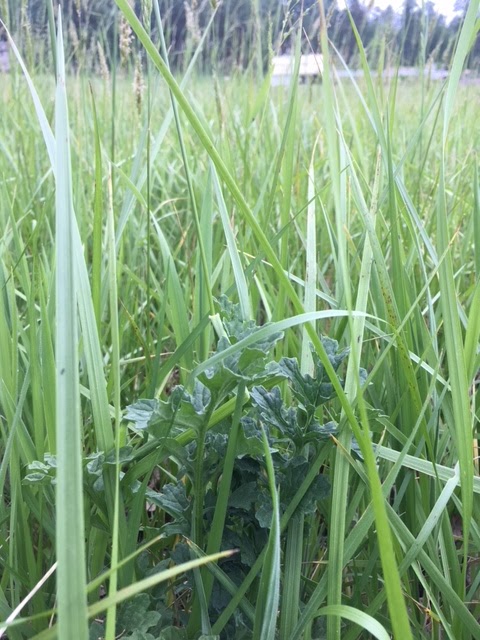
 
While going through my collection I found the 1987 watercolor of the Christmas tree farm. I was briefly inspired to paint the same scene as I see and feel it today. On second thought, I am not excited enough to immediately go out and paint in my old style. A more abstract distillation will take incubation in my mind.  I think I will select the flight of the swallows over the open meadow where the wind blows the grass that moves like waves.
        I took a picture with my phone. Taking pictures gave me new perspectives. But no camera can capture what I feel about the energy of the open space. When I complete the painting, I will update this post.
        It is fun to reminisce but mixed with the fun is making difficult choices requiring retiring some of my past work. Retiring too much can be depressing. But enjoying the new open spaces gives me a sense of accomplishment. I am not preparing even medium sized surfaces because as of late my small works are encroaching on more and more nooks and crannies. More paintings are stored closer and closer together on the walls.  I not only need more space to continue painting but I suspect that my work on paper as old as 60 years degrade- even acid free paper may degrade. I suspect dust mites are seriously worsening my husband and my allergy symptoms.
          I need to set priorities to make these difficult decisions of what to keep of my own and other artist's work in my collections.  My number one priority is having a personal relationship to the content of my work as well as a personal connection to other artist's work in my collection. Number two is keeping representational work from each period. Number three is keeping work representative of my series including paintings of waterfalls, water in landscape, self portraits, vases, dragons and fantasy.
          Each piece of importance will be supplemented with a handwritten story. If I do not have a good enough story, I will retire the painting. If the paper is old it goes into the garbage. If it is new and acid free, it is cropped to make greeting cards.   I hope dust mites will not be a problem if I keep art work sealed in archival museum boxes.
          I feel some time soon in the future I might again market my work. With my strongest work and a catalog of the ready to hang work, I hope to impress a gallery that will promote my work whole heartedly. Since mostly my best work has been sold over the years, I have on occasion received some of my work back. Some have willed my paintings back to me or my heirs. I hope other collectors will do the same.
May 15 UP DATE
This morning  I woke up with the realization that my body of work is sentimental. My process of keeping only works that I can write a story about is a sentimental visual diary. Hard to admit sentimentality because my art professors cringed and criticised  saccharine sentiment in paintings.
         Also I foresee more clearly the second watercolor to show how I feel about the change of the meadow since 1987 as seen from our back yard.  As I paint the vision may change but at this moment I see the field of grass in brush strokes like Van Gogh's painting of a field with crows. But not crows in the air. I see swallows.

Wednesday, August 15, 2018

Photographic aids for establishing a point of view for painting


These pictures were taken with my I phone holding it way above my eye level in the one with sunflowers and sprinkler.


I held the camera below my eye level to take the selfie of me in the blackberries.


The camera lens finder or binoculars are tools useful for inspiration to paint.. When painting on location I have used both to help me select from too many stimulating subjects outdoors.  These four photographs are examples of taking a pictures with the camera tilted  upwards like the point of view of a child. I like to keep  the innocent child-like excitement in my painting and the perspective has something to do with the drama and charm in my painting.

Wednesday, June 27, 2018

What does painting from the mind’s eye mean?

Straits of Magellan

When I was 17 and knew I was going to be an artist I met a well traveled  Reed College student who claimed he could never be a fine arts painter because he could not visualize in his mind's eye the kind of non-verbal vision that could be seen with the eyes.


Back then I was unaware of the possibility that paintings could come from a complete detailed image in your brain. Some savants have photographic memories and can look at say the Portland city scape and then paint a large mural with exact detail of every building without any additional reference to photographs or repeatedly looking at the scene..

  I like to think that the term "mind's eye" might be more about creating an interpretation or knowing how to create feeling in a painting.  My painting comes from a complex process not just from my brain but muscles of my whole body responding to my emotions. My emotion enters into how fast or deliberate I paint. My process is a necessary collaboration between the paint and surface and the atmosphere. Any mark that starts the painting  stimulates a response whether I was work from my imagination or working from what I was seeing around me.

Intrigued by the Reed College student's belief that the "mind's eye" is necessary to be a painter artist,  I still try when I am awake at night and not going to sleep, I try to visualize marbles in my mind's eye. I get so I can almost see a blue marble like the earth, a crystal clear ball and a cobalt blue ball but I can't see them independently of labeling them with words first. 

If I think of the term "visualization in the "mind's eye" in a wider sense, I come closest to painting the first response to a place when I have a strong feeling and a need to put it down in the most direct and economical way.  During the painting that could be considered coming from my "mind's eye" I am in the present and feel alive and thrilled. These three paintings are rare paintings that are completed without dramatic modification after my first reaction to an outdoor place.


This one was almost completed in one time without modification.


Wednesday, June 20, 2018

A dream painting commission

A 24" x 48" oil painting for a daughter and son-in-law who know I like to paint large


A daughter of mine wanted a painting I did from Church Lake in Washington State. It sold 17 years ago.  A few weeks ago the owner brought it back for painting over repairs to a tear mended by a conservator.


Looking at the results surrounded by my other paintings, I wanted to do more like the daisies. It was a memory painting of Church Lake but I tipped the background to make the distances closer and more dominate as though the painting was in a canyon.


 I have done one other landscape painting in which the foreground drops into a hole in the middle ground.
I am happy to paint a commission for my daughter especially since I already wanted to do the subject. But she wanted it larger and a longer panoramic view.


I found a photograph taken from low on the ground which makes the snow peaks appear higher and gradually creating a hole in the middle ground. The picture was taken on the Coffin Butte Trail near Iron Mountain in Oregon.  Photographs are one thing my paintings another form of expression.


I like challenges and do not want to repeat a past painting. The requested a 24" x 48" size made it more difficult to keep the juicy oil effect all over the canvas than the smaller one my daughter liked. The representation of the photo was not my goal making it more difficult to know when the painting is done.


 I wanted the energy feeling as though I was painting "a la prima" on location. So I didn't look at the photo as I began laying in thick oils to the upper left corner then working all over. So I needed to keep up the rhythm of my first "all over the canvas paints. The painting could have been done the first day except the paint wasn't all thick and juicy all over. So the next day I did a sketch trying to firm up in mind the placement of visually recognizable flowers, driftwood, rock and mountains then just as it was almost complete I sketched again to warm up before I began for the two hours it took to finish the painting.  Maybe this painting will stand up to the test of looking at it for a few months before it is hung in my daughter's and son-in-law's home.


Wednesday, April 04, 2018

Aiming for Plein Air Watercolor Paintings Displayable Without Glass

Experimental watercolor painting from the 70's  upon which I build my current direction
Last week in preparation for painting outdoors, the studio window view was the subject for trying some prototype palettes where I mix tube or pan colors with diluted Liquitex Gloss Medium and Varnish. This is a technique Professor Heidel introduced me to in a summer school class I took after graduation in the 70’s. I painted the picture of an adolescent dancer on the back of a 21 1/2” x 14” scrap piece of paneling covered with gesso.

This year now  approaching 75, I decided not to use glass and decided to incorporate some new products like absorbent ground for painting watercolors that can be displayed without glass.

The four window paintings soon became more than an experiment. Observations while painting the first painting (upper left), led me to seeing the similar shape of the brush bristles to the rhododendron buds. Then a neighbor pushing a stroller passed my view and I thought the child was a bud beginning to blossom. So I named the painting “Promising Blossoming”.
The second painting, “Creating by Cutting” is focused on telling what I am thinking in the painting process. In composing a painting I cut down my view to a few things or elements like colors shapes and lines.

 The third painting is “Connecting Releasing”.  Releasing balloons is joyous to me like letting go of control. When the painting was all but complete, I saw I could put a figure waving in the two windows across the way from me and the idea came to me of connecting and releasing as being important in the creative process. Releasing the critic while having little direction in mind, trusting the subconscious to take command while bravely putting down color and texture knowing the ideas will flow just as the theme evolved for this series of illustrating opposites in my creative process.

The fourth painting is “Taking and Sharing”, another title about opposites predominant in my painting process. I take ideas from nature and share them through my paintings.
Many more themes, colors and textures can be achieved with the beautiful transparencies and luscious buttery heavy body acrylic white or layers of absorbent ground. Especially advantageous to me is spending more time painting and less time cleaning glass. The finished piece is lighter weight making transporting and hanging shows easier.

There are some hurdles still remaining for me to overcome in learning to paint outdoors with watercolor thinned with acrylic paint mediums. The mediums can put a hard film over the paint in the palette rendering them unusable.  so I am trying to keep the watercolors separate from where I mix them with medium. Palette knife is an excellent way to move the pure watercolor to the mixing area where poured medium is mixed into it with a brush. Of all the pocket pan color palettes that I own, I selected two VanGogh palettes because each has a deep well in which the half pans sit.  I remove half the colors in each leaving deep wells for the medium.

Perhaps the best palette is the larger palette for tube colors because there is a trough at one end of  each of the five mixing areas where poured medium can be stored far from the pure watercolor.
When painting outdoors I will need a bottle for dilute medium and a bottle for water. I am nearly ready to paint outdoors.


Wednesday, January 03, 2018

Dec. 24 - 29th adventures at Turneffe Flats Atole in Belize

When traveling and on vacation, I like to make accordion folded watercolor books devoting a couple pagess a day to what is memorable to me.  This is a 16 page book with memories from a week's stay. Eight more pictures will be posted tomorrow.


Thursday, November 16, 2017

Master Artist Klimt Used Negative Space and Placement of the figure for Expressive Impact


In Gustav Klimt's portrait II of Adele Bloch-Bauer the colors and style of  painting likely refers to
early 20th century Chinese Mille Fleures Imperial type porcelains.


(The Adele portrait is from Wikipedia. The detail from a porcelain is from my personal photograph by son-in-law Samuel Edge.  The vase is now on loan to The Jordan Schnitzer Art Museum on the University of Oregon campus in Eugene, Oregon)


The Golden Girl, The Extraordinary Tale of Gustav Klimt's Masterpiece, Portrait of Adele Bloch-Bauer by Anne-Marie O'Conner is a scholarly book by a journalist.  From my painter's perspective and my Jewish grandfather's knowledge of the Silk Road influences to European art the esoteric symbolism was missed by O'Conner. 

  The second Adele Bloch-Bauer portrait (1912) is a special piece of historic symbolism. The background colors are the same as on Chinese porcelain Adele was known to collect.  Some colors were developed in the Levant and Europe carried to Asia by Arab and Jewish traders. In the 19th Century improvement in color s was assisted by the Jesuits. The Chinese figures and flowers in the background are in the style of Chinese porcelain painters making the portrait painting symbolic of the back and forth exchange of technology and artistic inspiration between East and West. With China's current interest in the Silk Road perhaps the painting will become part of the tourist experience.
Probably the gold leaf in both Adele portraits has special significance as on the porcelain vase. According to my grandfather the gold in the negative area is like the gold thread that connects life past, present and future. Gold leaf on the edge of pages in a book makes each page precious page symbolic of a day of life.

Am I going too far to see Adel likened to a porcelain vessel?  Her skin as luminously white as china? The rim of her hat - the abundantly flaring lip of a vase edged in white? White symbolizes mourning. The red is symbolic of virtue and truth.  Black symbolizes bruising and evil according to the book,  Outlines of Chinese Symbolism and Art Motives by C.A.S. Williams, first edition 1931. The stylization of  her body - the body of the vase with arm and hands the handle?  The tiny feet the base of the vase?

To see more of Klimt's paintings and see a bio look at this web site:
http://klimtgallery.org

Future posts will cover how other master artists have employed negative space.