Comments, relating to the topic, are welcome, add a great deal to a blog, but must be in English, with no profanity, hate-filled insults, or links (unless pre-approved) To contact me with questions: rainnnn7@hotmail.com.


Showing posts with label OSFW Hatchery and Research Center Fall Creek Art Festival. Show all posts

Wednesday, October 23, 2019

by Diane: Brushing up for teaching watercolor workshop

Ten more days for me to get ready for teaching a watercolor workshop Saturday, November 2, at the Oregon State Fish Hatchery and Research Center Fall Creek Art Festival.

This year the workshop will be entirely different in focus from years past. The focus will be on the brush and the marks they make naturally. The marks from a single brush is dependent upon how it is filled with paint or ink, how it is held and moved. The brush marks can be individual to each person. Their desires, skills as well as the paints and surfaces they choose enters into the results. The numerous ways the brush is handled is like a vocabulary is to the writer.

Brushes are advertised as if each brush has a single purpose like liner, blender, mop, round pointed for detail, or long ones for calligraphy. If limited to their advertised label, their full range of natural mark making characteristics are missed. Perhaps the advertising labels are to get more sales. For example, the number 1 liner made by the Princeton Art and British Co. has extraordinary possibilities. When the entire length is rolled in wet fluid watercolor or ink so it  holds its maximum capacity, it is capable of making a line that goes, goes and goes increasingly thin and faint.
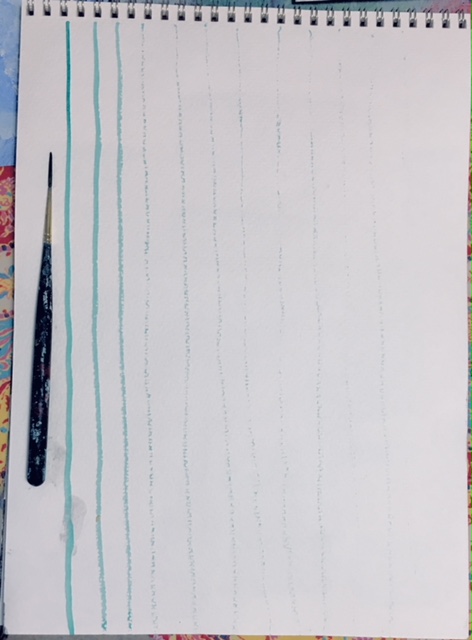
 
If the 1/8" wide by 3/4" long liner is swiped sideways along its length it makes shapes.
Many lines close together make textural shapes. These two methods are among many ways to use a single brush type. For me personally, getting to know a brush is a springboard to abstracting the subject as well as revealing a story  of how the painting was made.  Secondly, as I become familiar with a brush, I feel  how it might be expressive of how I feel about a subject.
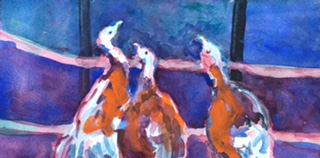
My fourth painting of "Turkeys in the City" has just a few different
uses of the liner brush other than the usual use of it for the rigging on ships or tree branches. The open spaces between the brush strokes makes it easy for me to make major corrections even as the painting is near completion. I just noticed the heads of the turkeys are too large.
  
 
The third painting of Wild Turkeys in the City was painted with a number 12 round Kolinsky Legend brush made from the tail hairs of Russian mink ( in last week's blog I wrote incorrectly that it was sable.) Because it comes to a point it makes good curved feather-like strokes. Also the large brush makes nice big washes. The signature characteristic of the big Kolinsky brush is the round corners from ample wet color stored in the many hairs in the brush's rounded bowl.


The first turkey painting to the right consists of a build up of layer upon layer of washes using the the 1/2" Simply Simmons 1 stroke plat long . During the process I would put a wash on and then leave it to do some mundane household task, coming back for another wash when the painting was completely dry. I became fond of this synthetic hair brush. In this painting I felt it was forced
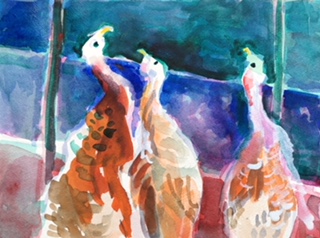

In the second painting of turkeys using the Simply Simmons 1/2 inch flat,  my initial drawing in paint did not go well, so on subsequent layers I was able to draw a new outer edge of the turkeys' heads. The right angle of the brush's tip lent itself to making angular shapes in the drawing and in filling in the background helping to unify the paintings. The lighter early drawing left a nice transition from the very dark background to the very white of the head giving the head a three dimensional form.


Branch with Fruit, Shih T'ao, Ch'ing period
Seeing an exhibit at the  Center Pompidou in Paris inspired my focus for the watercolor  workshop.  side by side were relics from prehistory with abstract works  of 20th century artists.  Prehistory A Modern Enigma reminded me to be mindful of how the marks of tools govern the form of all visual art expression from calligraphy on paper to lettering on stone. From watercolor paintings on paper to silk screen prints.
 The Chinese letter shapes are composed of a number of specially designed brush strokes. The form of alphabets made by the brush are formed in the character of what brushes will do. The letters made by a pen nib and brushes repeated many times take on the different characteristics of the tool that made them. 
Writing with pen or brush also take on the personality of the writer. I want to extend the personal touch to my own painting and inspire students towards their own style in the use of the brush.
 

Wednesday, October 16, 2019

by Diane; My changing ideas on teaching about paint brushes

Students in the past pressed me to teach them the uses of each kind of brush. They were used to artists on TV always talking abut the kind of brush they were using for different painting tasks. I believed brush detail to be just chatter to fill in the empty times as well as making it easy for listeners to copy.
My approach was to leave detail unanswered so students could embark on a painting as though it were a journey of getting to know what their tools can do as they paint. The brushes were unimportant as compared to quality paper and color and composition. These other basics were all I wanted to tackle in my short hour and half workshops at the Oregon State Fall Creek Hatchery and Research Center Fall Festival the first Saturday in November the past nine years.

The natural hair1/4 inch Blick Master stroke Eclipse one stroke inch and a quarter length holds enough ink to continue painting for a long time.


The 1/2 inch synthetic oval Golden Fleece was the only brush used on this 12' x9" watercolor.The oval shape challenges me when trying to fill in corners so in response I abstracted the hands. The tool can make for shaping differences.
 
The 1/2 inch synthetic Simple Simmons 1 Stroke plat long brush holds a reservoir of paint. It has so much body that the squared off edge works its way into the painting.
 
This much abused 1/2 inch sable brush has been used extensively with my acrylic paints and there is build up of hard paint at the base near the brush ferrule. Some hairs are broken and it separates as the brush empties the paint. Love these brushes with character.   At the workshop I will provide some of my old brushes.

Thursday, October 10, 2019

by Diane; A fix for the painting, Howler Monkey Mother


 Yesterday I was unhappy with this painting because it suggested black face to me. After washing away surface color that has not stained the paper, I feel better about the painting. Also I enjoy the way my previous building of the shapes left a texture. Yet I like the contrast before washing the painting and will use the contrast with colors that work with future subjects.
 
Red Howler Monkeys 12" x 9" on smooth hot press Instead of a filbert the brush is Simply Simmons 1 stroke * Plat Long 1/2"
Hot press papers are good for fine detail but also like here the colors spread in great blooms with most of the pigment staying on the surface. Every little touch shows. Also the hot press shows the full brilliance because less pigment doesn't soak into the paper. In this one the brush strokes did little to shape volumes.  I was distracted by the marks in laying down the under-painting in the first step. So never blocked volumes in an abstraction natural to the character of the brush. The lines were made by turning the brush sideways. The square flat shape strokes were from the flat side of the brush.


Since the Fabriano hot press paper was a big factor in how I reacted while painting Red Howler Monkeys on Thursday's I returned to cold press Fabriano so it would be more comparable to  the painting that was washed in the bath tub. The perfect synthetic Simple Simmons plat was the only brush I used. the rectangular strokes are very regular. My preference is the filbert brush.


Next Wednesday the blog will be about the influences I feel from the trip to London and Paris.

Wednesday, November 08, 2017

Watercolor Class at Oregon State University with Oregon Fish and Wildlife Hatchery and Research Center Fall Creek Arts Festival

Saturday, November 4, at the OSFW Fish Hatchery and Research Center Arts Festival I enjoyed a morning and an aftenoon class of enthusiastic painters. Adult sisters assisted me and painted too. There were children accompanied by parents and one family included a grandparent, also some individuals with their caregivers. Everyone became engaged. 

Only have pictures of  a few of the paintings from the class.


  Attempting to be inclusive of painters in every stage of development including children and adults who knew what they wanted to paint. They were encouraged to go for their vision. For those who wanted a challenge or idea to start, I had an assignment for them.

My teaching exercise was on the techniques of  laying down a general compositional plan while being open to allowing the character of the paint to suggest new directions. Of course the creative process includes being free during the course of painting to reject somethings that are not desired. My goal was to disprove the widely held belief that watercolor is difficult because once a mistake is made the painting is ruined.  One reason watercolor is a workable medium is that the white of the paper can be restored by applying opaque, acrylic absorbent ground.
  
Lesson plan: With just two hours to paint, the assignment must be quickly explained leaving most of the time for the hands on exploring of watercolors. My challenge is great because students are four years old to ninty. Some had limited English language skills.  The basic need is to be simple and clear but still have enough meat to hook the most experienced painters.

Lesson: Very important! The placement of your subject within the picture is very, very important!   Deciding how much space surrounds the subject is your first step in making your painting expressive.   Whether tiny or popping out, whether placed to right or left top, middle or bottom determines the shape of the surrounding areas.  Whether the subject is small or large, the main subject and surrounding space project feelings and stories.


The size of the bird is significant as well as the central location. Top bird shows dominance, to be feared. the middle bird smallest with wings up in surrender. The bottom bird relatively big but is perceived as small because it is intimately close.

Student example of work using the technique of first painting negative area around subject while being mindful of allowing enough surrounding space to contribute to telling a story with emotion;

 
Whether the subject is recognizable or more abstract, the placement in the picture space is important to expressiveness.  My sample I cropped to make it more expressive:
 
A student's watercolor painting is  a  good example of the paint doing what it likes. Allowing paint to move and dry as it likes leads to happy accidental effects that if not fought can suggest a fun carefree ride to new imaginings. Watercolors have character in uneven coverage that painters can come to happily accept it's surprises.
 
In the next blog Wednesday, November 15, a demo will be illustrated and explained.