Comments, relating to the topic, are welcome, add a great deal to a blog, but must be in English, with no profanity, hate-filled insults, or links (unless pre-approved) To contact me with questions: rainnnn7@hotmail.com.


Saturday, December 16, 2017

seasonal changes

by Rain Trueax

What does Christmas mean to you? In my life, it has changed from the beginning, the first time I was told what it was, to today. I have had times where Santa Claus was what was important. Those were the years, when Santa came Christmas Eve. We would be sent to our bedroom because Santa was coming. Then, the excitement was to come out and see what had been left under the tree. No matter how great the gifts were, Christmas Day meant the whole Trueax family gathering for a big dinner, more gifts, and much cousin fun.

Holidays change their meaning through a lifetime. My own is an example of that. From childhood, to parenthood, to empty nest, and old age what Christmas means to me has changed. Is there one right thing for it to mean? If someone looks at it religiously, probably there is.

Religiously, I could have reincarnated multiple times for the different ways I have seen Christmas. Most years when I was young, it did not mean going to church. When I reached young adulthood, I became a Catholic and Christmas meant a midnight Mass. I loved the ritual of the Catholic Church at Christmas. I loved the procession of the priest down the aisle, the candles, the nativity, the smell of candles and incense, the beauty of being there with all the fragrances and age-old rituals.

Religiously, I also experienced what being in a small rural community meant for Christmas. When we first moved to this farm, 40 years ago, our children went to a two-room schoolhouse, where the Christmas program meant a nativity. Having come from a city school, where it was a 'holiday' not Christmas, this was exciting. Christmas out here was very traditional.

We also became involved in the local church, where adults and children put on a Christmas program for the congregation, with music and small scenes. That meant December was about Christmas practices. Such fun to plan what it would be each year, what music, what skits.

The most vivid one in my memory was a mix of that and tragedy. We were inside, practicing, when we heard the crash of an automobile outside the church. We kept the children inside, all the men, including Ranch Boss, ran outside to see what had happened. Power lines were down, as a car had crashed into the only power pole that could have stopped its momentum short of the church. Determining those lines were live and the person inside was not moving, they waited for the police to arrive. Later we learned that the young man, who had been drag racing his brother on our narrow country road, had been killed. Tragedy and ritual side by side.

Through my lifetime, Christmas meant parties, dinners, luminaries, dinners that required three tables, family/friend gatherings, church, rarely snow, and now today it's mostly just Ranch Boss and me. Sometimes it has been spent on the road between our Oregon farm and Tucson house.

What we do for the day has changed a lot. I do not send out cards (economics and the dwindling reason to do so). I only sparsely decorate. This is from a woman who has a sizable Christmas Village. Who used to decorate the whole house with greens and a big Christmas tree, decorated with ornaments that went back to my and Ranch Boss' childhoods. It makes no sense to decorate since nobody comes to see them. I don't feel sad about that but just an acknowledgement of what is and changing times.

Life changes and I feel, given my age, in my seventies, that is okay. I remember all those earlier years but have had to release them, not dwell on them, be glad I had them, to avoid ruining what is. Would I like all my family under one roof for Christmas Day? Yes, I would, such is not my choice. Those days are gone. I can feel nostalgia for what was and release it for what is yet to be. All images from Stencil

Wednesday, December 13, 2017

Craftmanship and Art

The spawning salmon painting is an example from a student's work at the November 4, Fall Creek Art Festival  Watercolor Class at the Oregon State Fish Hatchery and Research Center. The primary focus is the salmon with four secondary subjects.

Some say class work is probably instructor influenced and cannot be considered as original art. However, I believe this student came late and had her own ideas. I like her painting so much, I wish it were my own. She has a main focus but many secondary objects. My idea was to limit the number of secondary things within the painting. So this is an exception to what I was teaching. I am humbled. 

While anyone can learn to make an artistic, creative painting with a few basic technical skills, a general belief is that not everyone who paints pictures are artists. Not all well made paintings are art.  Certainly there should be some word to recognize extraordinary commitment and continued practice and deep involvement in using materials or ideas creatively to express their own original story. Everyone has their own individual story, some are more committed to self-expression.  There must be, also, a word for the people whose art has informed all aspects of their decisions of how they live.

Art can also be made without technical craft like when Picasso made a Bull's head from handelbars and a seat of a bicycle.  Two unrelated things put together in new context is creative art.
from page 10 of H. W. Janson, History of Art,

Saturday, December 09, 2017

Christmas from the Heart

by Rain Trueax


After writing about inspiration, this post seemed apropos, although I hadn’t planned it this way.  One of the advantages of being an indie writer, is being able to change directions when the Muse comes up with an idea.


With this being the Christmas season, I began regretting that I had not planned a Christmas novella or short story.  Since I began publishing my books, I’ve written four novellas and two short stories, centered around Christmas.  The short stories were for anthologies, one of which no longer exists.  The novellas have three connected to longer books in the Arizona and Oregon historical series.  They all stand alone, as in can be read just as what they are. 

Although I have put Christmas in a few of my longer books, it is not something I casually do.  Christmas is a huge deal in our culture for many people.  There are a lot of expectations woven into it.  Putting it into a book presents the possibility of it being a disappointment to the reader, for how the characters celebrate it or their attitude toward it.  I only use it in a book if it fits the theme.  Yes, most books have an overall theme.  There is a lesson the characters are going to learn.

My themes for Christmas books tend to be around the expectations embedded in the season.  That means love, giving, disappointment, hope, joy, fun, religion, and mystery.  None are paranormal, as such, but the very idea of the season, about giving without the expectation of receiving, is a mystery itself.  When expectations also involve religion, they can be so high that whatever happens it is a disappointment.

Last week, what I began to think about was that I would like seeing these Christmas books together.  They don’t exactly belong together because two are contemporary and four historic.  The characters range from young to old.  Their common link is Christmas and its many messages. All but one can be purchased separately-- well, the other short story is in an anthology that is still available so far as I know.

This is where being an indie writer comes into play.  I had the option of stopping temporarily on the work in progress and begin what it would take to bring out a Christmas anthology.  The Muse was telling me I should do this.  This is never about how much money something will bring in.  It is about following the creative voice.  I am fortunate on several levels, that I can do this.  One of those levels is having a husband who can do the techie part of the project.

Because one of the short stories, Connie’s Gift, was written some time ago and is no longer available, I put time into editing it for this new project.  I particularly liked having it in the anthology, because it takes three characters into a time between longer books and explains what they were doing.  One of the characters does have a mystical gift.  Connie's story is about her use of that gift and what it means - -not just at Christmas but anytime.

Besides editing that book, I needed to create a cover for it and one of the short stories where I hadn't had one. Then there was the need for a banner. 

I consider this anthology to be potpourri.  If someone is in the mood for Christmas stories, these, while not all connected to each other, offer different aspects of Christmas and what it means to individuals.

Again, as a benefit of being an indie writer, I could set the price for the book at 99¢ and make it only available for the season.  Sometime in January, it will be pulled, maybe to come out again next holiday season, with hopefully a new story.  The creative journey tells me this may or may not happen.  I think to be an indie writer, or an indie artist of any sort, it is important to be able to go with the flow.  That is more fun sometimes than others.  This was one of the fun times.

So if Christmas stories, short ones, interest you, give Christmas from the Heart a try. It will disappear sometime in January to reappear maybe next year if it seems right for the time. If you have read Tucson Moon and Arizona Dawn, this book slides between them. It has a secondary character where his story began in Arizona Sunset and is expanded in Echoes from the Past. That's the other fun part of being an indie writer, discovering all these connections and being able to use them.  


Available through December and maybe some of January at these sites exclusively and for 99¢:

https://www.amazon.com/dp/B077XLLQ1M
&
https://play.google.com/store/books/details/Rain_Tueax_Christmas_From_The_Heart_Anthology?id=GkpBDwAAQBAJ

Wednesday, December 06, 2017

Admiring Edward Hooper's Moodiness Created Through Composition


"Lewis Barn", 1931, a watercolor by American artist Edward Hooper can be analyzed as to how he created the mood.
        Is the main subject the barn with the dark side facing left but the roof points the eye upward?  The upward movement doesn't uplift my spirit.  The dark lines and areas behind zigzag me back to the unseen back of the barn.  From the the wide dark band does your eye skip through the barn to the small window? When do you see the dark fence posts pointing  the eye toward the small square window,  plus the dark earth zigzagging toward the base of the front of the barn underlining the window? The fence posts might be seen secondarly.  The small static square window sets a mood of forlorned mystery for me.  Does your eye continue to circle in a figure eight or does it stop at the window?


Below is a later1955 painting, "South Carolina Morning." Is the main subject the woman in red or the woman grouping with the doorway? She stands out by color hue of red against white and not so much from the color values of darks and lights. The mystery is why she is standing in a doorway. The emptiness of the blue sky and light ground draws me into her.

(The pictures by Hooper are taken from the book, Silent Places, A Tribute to Edward Hooper, Fiction Collected and Introduced by Gail Levin)

What I admire is every part of his paintings is essential for creating the mood and mystery with no distracting extra information in the negative spaces. Hooper has no fear of cutting the composition with a horizontal right in the middle of the painting pointing to the main focal point. It is no wonder he is widely admired.

Saturday, December 02, 2017

Inspiration, Craft, Tools Part III

Creativity is allowing yourself to make mistakes. 
Art is knowing which ones to keep. Scott Adams

Although I've written about tools and craft first, I think for me creativity and inspiration did come first-- long before I had the means to share what I was feeling and thinking. I believe we are all born creative beings.  The natural instinct, even for a small child, is to make things.  

From those first impulses there can be those who encourage and uplift us. This might be friends, teachers, parents, etc. Inspiration also is encouraged from within. It is the small, still voice that says we can do it. It does more than that though as it leads us to see coincidences, serendipitous experiences, and recognize what that can mean. I call it the Muse. Is it a real spiritual entity, it might be or simply be part of our DNA, our ancestry, our brain.  What it is I cannot explain logically.  I just know that the more I listen to the Muse, the more it is accessible.

There is another strong influencer from within. While parents, friends and society can help or stifle our development of creativity, it is what comes from within that is most effective in shutting us down with doubts.  At our first creative impulse, the Inner Critic begins with-- worthless idea.  You can never do anything with it.  

This negativity is even stronger when it's an original idea - -something that has never been done before.  The Inner Critic has some impact on our use of tools and craft but far less.  It might suggest spending money on a new tool is foolishness.  It might try to argue us out of taking a self-improvement class.  The attacks, however, are not at our own worth so much as limiting our effectiveness. It can do far more damage where it comes to inspiration.

These two inner voices compete where it comes to using our creativity. The Muse encourages us, while the Inner Critic blocks.  How well these two can work together probably determines the likelihood that we will involve ourselves in creative endeavors like writing, painting, or so many other places where inspiration lives.

Interestingly, my earlier concern over the changing technologies hurting my creativity may have some grounds. A story goes with this.  

There is a painter whose work I have admired.  She had great success as a wildlife artist with fairly realistic paintings of wild animals.  A car accident led to a broken arm.  She could not paint with her dominant hand.  When she painted with the other hand, her work became more colorful and abstract.  She had not expected this to happen.  Was it right brain/left brain?  It is hard to say, but it is interesting in how inspiration and creativity work. 

Now, I won't say this would happen to a writer, but I think when I use voice recognition I write in shorter sentences.  Some of that might change when editing, using a keyboard, happens.  The thing that I have come to believe is that we can be impacted by the tools we use.  This is probably why some writers still write their rough drafts in longhand.

Many people, and I have been one, keep their creative work to themselves.  They do this out of a sense of self-preservation.  There is a price, however, that they may not know. To not put your creations out into the world, not to offer them for sale, and not to open yourself to reviews by others, can be a major block to having more creativity, i.e. inspiration, come into your life.  

This might seem hard to believe if you haven't been engaged in creative work, but as I have said, the more you write the better you get at writing, this is also true of inspiration. 

Get past the Inner Critic, close off listening to anything that is not intended to improve your work, take your work to the world-- or as much of it as the world wants.  Using your inspirations will lead you to seeing them everywhere. The more you open yourself up, the more there will be. Learning to think outside the box.

This is part of the philosophy of abundance and understanding what that means. We live in a bountiful world where we need to look for how we can use what is there, which sometimes means sharing it with others. This doesn't mean necessarily material riches. It means a creative lifestyle with an openness to all that is-- within and without. An abundant lifestyle is not about taking everything, it's about using wisely what we are given, knowing that the more we do this, the more there will be.


Creativity is allowing yourself to make mistakes. Art is knowing which ones to keep. Scott Adams
Read more at: https://www.brainyquote.com/quotes/quotes/s/scottadams104102.html?src=t_creativity

Wednesday, November 29, 2017

I Have Painter’s Block - What I Am Doing To Get In The Flow


I have not painted for several weeks resulting in being restless, worried, and out of sorts. I need some creative excitement like painting. But I kept finding something to do other than painting. Realizing I had painter's block, I took the following steps for preparing to paint again.
1) Checked my photos for my favorites of this year like the sky with clouds before the storm.
2) Took a few minutes to organize and make space to paint in my studio.
3) Borrowed  “From Generation to Generation” an acrylic and oil painting from Barbara Levine who has similar interests as mine but has an entirely distinctive style of her own. In the past we borrowed each other's paintings before exhibiting together. Last time we got together we both didn't know what we would do with our new art work. Like Barbara I have reproduced my grandchildren's art in my paintings, I have not done one with the sense that my creative journey is passing as my heirs are about to blossom and take flight.
4) Checked where I was running low on supplies and ordered some on line. Took advantage of Michaiel's Black Friday 70% off all canvases and purchased a 4 foot by 6 foot canvas and three 3 foot by 2 foot ones.
I hope soon I will be in the swing of painting something meaningful to me. Whammy! OH Oh! I am putting a terribly difficult demand on myself. I don't need to make every painting meaningful. That pressure is part of why I have painter's block.

So a couple of days later I had a whole day free to do the underpainting. I loved mixing the colors and how drum tight the canvases are.


Saturday, November 25, 2017

Inspiration, Craft, Tools Part II

 by Rain Trueax

No matter how fantastic your idea and inspiration might be, if you cannot convey them to someone else, they remain yours. Basically, a need for craft is true for most of the arts.  Of course, there are natural born talents who create a new way of presenting their ideas.  They are rare.  Most who write, for example, have either taken classes or studied extensively with manuals that teach basic grammar.  Only when you know the rules can you break them with purpose. The big thing in writing is the need to convey the idea in a way someone else can understand.

The case has been made that sites like Twitter are creating a whole new way of communicating, using initials and symbols.  My personal belief is the only ideas that may be communicated that way, are shallow. Yes, the first humans used pictures and then hieroglyphics. In many cases, we are still guessing what they meant.

For those who want to write a book, it is important to take time mastering punctuation, spelling, and sentence structure.  There is a lot to learn to write in a way that does not takes the reader out of the story.

Of course, this is tougher the more educated the reader might be.  An English teacher will have higher standards and is more apt to be bothered by misuse of words, commas, and sentence structure.  Issues like split infinitives will likely pass right by many readers-- if the sentence still makes sense.  Dangling prepositions bother some readers, while others may find avoiding them more disturbing to flow of the story.

For me, writing dialogue is the most fun-- with the least rules-- other than make sure each character speaks in a way that is consistent.  To give readers a sense of character by how the person speaks can be a challenge but even more is stimulating.  Even there, craft plays a role that goes beyond inspiration.  Writing a scene where the word said appears too many times will break the flow.  Craft is really all about maintaining the flow.  Learning to make a scene project the qualities desired in the characters is a mix of rules and inspiration.

Besides grammar rules, there has to be an understanding of the requirements for each genre.  I think this is best done by reading a lot of books in that genre.  What readers of science fiction or mystery will accept will not be the same as those reading serious novels or romances.  Since a lot of writing today involves a mix of genres, some standards will not be consistent.  This is where inspiration comes in.  New standards for successful writing evolve as does the culture.  That does not mean that I believe LOL belongs in any novel unless the character is typing an e-mail.

One of the cool things about computers is how many articles can be found on requirements for successful writing.  When in doubt about something like the Oxford comma, I can tell you, with confidence, that you can quickly find articles that contradict each other.  In the end, you may know the rules and still break them IF you have a good reason - -one that benefits the flow of your story.  You will still not please that English teacher.

So learn the craft, read articles like this one, [10 Rules of Writing].  Craft may seem less interesting than inspiration, but it is the bridge to anyone else reading your work.  There are many ways to learn it. I worked one year with a consulting writer, who I had been advised by an agent would improve my romances.  This was in the Nineties and even then, it cost about $1500.  I would mail her typed pages of my work in progress.  She would mail them back, highlighted, with extensive notes in the margins.  That work with her was like a class in writing romances, where there are important expectations.

What I advise to any wanting to write--write, I will add to that-- read books on writing.  Read articles on writing technique.  When you get reviews on that book, your craft will often be remarked upon-- negatively is most apt to show up.  It may not seem as important as the inspiration behind your book but without it, nobody else will know because reading it will be a struggle they are not willing to endure.

I think some of this is going to be harder for the generations growing up in a time where learning proper English is not part of a full education.  When I was a girl, we learned to diagram sentences.  It taught us the parts of a sentence to make it work. We learned to [correctly use tenses].  I keep a cheat sheet by the computer to remind me of the rules. A comma in the wrong spot completely changes the meaning of a sentence.

All of this matters a lot to a writer but also, to someone writing a resume.  My hope is that some educational shortcuts will be reconsidered.  Yes, a computer can correct your spelling-- if you are anywhere close to the right one. It does nothing when you have to write something in longhand. Yes, craft doesn't seem as exciting to read about or take the time to learn-- especially for those who have come to believe a tweet can say it all.  I have two words for that-- it cannot.

Finally, there is the form the story will take.  While this might seem to be under the heading of inspiration, there really is a form that is classic, that satisfies a reader, and which takes some experience to master. In my early learning about how to write a scene or chapter, I heard about the W.  What this means, is that (this is true for paintings also) when you have a time of excitement, you need a time of rest-- hence, the W.  The characters go toward a negative time and then have a respite.  Romantic moments are followed by stressful ones.

Joseph Campbell (a link to his work below) spoke of the hero's journey.  This is the structure of mythologies which have survived time. In terms of basic adventures, there are only a few that can be used over and over and in different ways.  The hero's journey will have certain key points, which writers can learn, using what most applies to their work and what they are trying to create.

It is true today that some so-called literary novels seem pointless as they meander whither and yon with no real seeming ending or purpose. They are sometimes even called classics. The thing is what a culture decides is a classic lasts until a new generation takes over. Our own generation does not get to define a classic for more than itself. I think those who learn forms that carry forth universal themes, their work is most likely to hang around.

A few recommended books on craft:


Next Saturday, inspiration. :)

Wednesday, November 22, 2017

Thanksgiving Thank You for the Support I Enjoy as an Artist


“East Indian Dancers”, my mother, Margaret Widler's egg tempera.

I am thankful for my family for many reasons. Their support of my creative journey whether thay understand my art or not is very valuable to me. An art teacher in high school and various other rejections through out the years makes me even more appreciative. My family support started with my parents who shared their creative interests with me. They took me to the the San Francisco Art Museum and lifted me up to adult eye level so I could see too. Then after I graduated from Portland State College with a degree in Drawing and Painting, mother helped to market my art for a number of years. My sweetheart husband, Don, volunteered as he always does to engineer aspects of making and exhibiting my work. Just this week we were considering yet another box, travel easel. My daughters also value my work and hang it in their homes as do my brother and sister-in-laws.

I feel the past 60 years was a charmed time period inwhich I had the leisure to develop my creative path.

Saturday, November 18, 2017

Inspiration, Craft, Tools Part I

by Rain Trueax

Creation begins with an idea, a concept-- inspiration.  Something is required to get from idea to reality, whether that is a book, an invention, a painting, or any physical manifestation. What carries that idea forth is a combination of craft and tools.  Idea ---> tools---> craft/rules---> Product. I know some don't want to think of a book or painting as products but whether you sell it or not, it is when it takes on reality.

Years back, when I began writing, I thought the tools I used, pen or pencil, encouraged my creativity.  Some writers never change their mind on that and always write their rough draft in longhand.  For me, I have changed tools as I've found something that lets me take the ideas formulating in my head to a first draft of a book.

An old, upright style, Royal typewriter was my first step beyond handwriting.  I still have it.  To me, it is quite pretty. It was a kind of thrill to see the neat type appear on the paper. It took strong fingers to make the letters equally dark. After taking typing classes, it was much faster than a pen.  Mistakes were covered up by small jars of white and a brush. Later, it was little sheets of white paper where you typed the mistake to cover it up-- mostly. Big mistakes led to wadded up paper in a trash can.

When the opportunity arose to buy an electric typewriter, I had no doubts that I could work with it.  No more worry about uneven letters. A different sort of tool, it was in the same family with which I was familiar. Electric typewriters took me through many rough drafts with boxes of manuscripts under my bed, a few sent off to editors only to be rejected. I loved the satisfaction of seeing the stacks of paper and knowing my books were saved for possibly a future time when editors would look with more favor on them.

When my husband suggested my using an Atari to write, I resisted as it seemed a step into something different.  Where it comes to new technologies, I am a Luddite. I was concerned that it would block my creativity. The typewriter was familiar and comfortable.

Then, I tried it.  Oh my gosh, it allowed me to move whole paragraphs when they were not in the right place.  I could erase whole scenes, with no paper and no white-out.  As for my creativity, this technology only made it better and faster.

The arrival of new and improved computers constantly lead to faster and better ways to write my books.  My Luddite side didn't protest and saw only advantages to a Thesaurus, spellcheck, punctuation checks and best of all allowing me to save the document multiple places. Word processing changed the process so much that it's hard to imagine thinking anything was better. I began typing all my existing manuscripts into it. That was a lot of work but better than boxes under the bed. I had no idea how much innovation lay ahead when eventually a book could be sent to a publisher and soon people could buy it.

One might think, that there would be nothing new beyond improved computers.  Or perhaps, I might have thought, except, I started hearing about those who were using voice technology instead of a keyboard.  They were able to see their words appear on the screen and in their document by speaking them into reality.

Luddite mentality kicked in.  How would my creativity, my inspiration work when I wasn't typing?  Would speaking scenes become a limitation?  I decided , while it sounded interesting another amazing step forward in technology, it was not for me.

When I noticed some early symptoms of carpal tunnel.  I posted my interest and questions in Facebook.  One of the other authors, Jacquie Rogers, told me she would be happy to talk to me about it in a phone conversation.  We had an enjoyable talk, and I learned more about the potential of voice recognition.  I learned I already had it on my computer with Word. She felt it worked better than some of the other programs that were for sale. She told me she writes about half of her books with it.  It also allows her to stand up while writing and even walk around-- that last is a biggie.

Part of my weight gain over the last six years has been sitting too much.  If a writer considers what she is doing as a career, it takes hours sitting.  They now say that for health, that is as bad as smoking.  It certainly hasn't done much for how I see my body.  I am fat, where most of my life, I had either been about right for weight or overweight.  Being fat is hard to take.  I wasn't sure that having voice recognition would get me enough exercise to change weight, but it would be healthier.

The question was, of course, the one I had worried about with each technology advance.  Could I think using voice instead of a keyboard?  In the beginning of November, I determined that I would find out.

The microphone Jacquie Rogers suggested was a Sennheiser.  I had doubts about it fitting over my head, but it had the advantage of keeping the mic close and in the same place for my voice. I ordered it and began going through the tutorial, reading suggested text. You are supposedly training the computer to recognize you, but it also helped me see when I had to slow down and which words were likely to not be recognized. I printed off that terms I'd have to use. You can't say quote. You say open quote. There are pages of instructions-- for now I don't need most.

That still left the question-- how would it impact the creativity I'd always felt concerned about. I didn't want anything to become a distraction for that inspired scene... I hoped. As might be expected, I started into it with the usual trepidation.  And then, the story began to flow.  Answer to whether I could tap into my inspiration was - -yes.

Some suggest, that you do not edit as you go.  I mostly do and correct when I cannot say the word in a way that the computer recognizes.  Surprisingly, the bigger issue turns out to be small words not the bigger ones that I would have expected.  To teach my computer to learn my voice with those words, I highlight and repeat them, eventually choosing from a list of possible words. The computer is helped by my taking the time to do that. It learns my vocabulary.

I still type, but this was written with speech recognition and a keyboard edit to follow-- especially in places where there was no way the computer would be able to learn a word.  Overall, it has been fun to learn something new and save my hands for other tasks. I am a fast typist; so it's not faster. It saves my fingers and wrists, and it works.

Next Saturday, I will write about craft as it impacts writing a book, a blog, a poem, etc..  That will take me to the following Saturday and what is the more exciting part of writing-- inspiration.

Craft and tools are part of the writers arsenal.  Without both, whether that involves a pencil or electronic device, inspiration is going to stay just within the creator.  I never dreamed that I could write a book with dictation.  But then, I never dreamed of all a computer might be to a writer. The beauty of where we are today is we can still use that pencil. We have the choice.


Thursday, November 16, 2017

Master Artist Klimt Used Negative Space and Placement of the figure for Expressive Impact


In Gustav Klimt's portrait II of Adele Bloch-Bauer the colors and style of  painting likely refers to
early 20th century Chinese Mille Fleures Imperial type porcelains.


(The Adele portrait is from Wikipedia. The detail from a porcelain is from my personal photograph by son-in-law Samuel Edge.  The vase is now on loan to The Jordan Schnitzer Art Museum on the University of Oregon campus in Eugene, Oregon)


The Golden Girl, The Extraordinary Tale of Gustav Klimt's Masterpiece, Portrait of Adele Bloch-Bauer by Anne-Marie O'Conner is a scholarly book by a journalist.  From my painter's perspective and my Jewish grandfather's knowledge of the Silk Road influences to European art the esoteric symbolism was missed by O'Conner. 

  The second Adele Bloch-Bauer portrait (1912) is a special piece of historic symbolism. The background colors are the same as on Chinese porcelain Adele was known to collect.  Some colors were developed in the Levant and Europe carried to Asia by Arab and Jewish traders. In the 19th Century improvement in color s was assisted by the Jesuits. The Chinese figures and flowers in the background are in the style of Chinese porcelain painters making the portrait painting symbolic of the back and forth exchange of technology and artistic inspiration between East and West. With China's current interest in the Silk Road perhaps the painting will become part of the tourist experience.
Probably the gold leaf in both Adele portraits has special significance as on the porcelain vase. According to my grandfather the gold in the negative area is like the gold thread that connects life past, present and future. Gold leaf on the edge of pages in a book makes each page precious page symbolic of a day of life.

Am I going too far to see Adel likened to a porcelain vessel?  Her skin as luminously white as china? The rim of her hat - the abundantly flaring lip of a vase edged in white? White symbolizes mourning. The red is symbolic of virtue and truth.  Black symbolizes bruising and evil according to the book,  Outlines of Chinese Symbolism and Art Motives by C.A.S. Williams, first edition 1931. The stylization of  her body - the body of the vase with arm and hands the handle?  The tiny feet the base of the vase?

To see more of Klimt's paintings and see a bio look at this web site:
http://klimtgallery.org

Future posts will cover how other master artists have employed negative space.


Wednesday, November 15, 2017

Diane Widler Wenzel's Negative Space Demo

Last Wednesday's blog was my lesson plan for a November 4 class at ODFW Fish Hatchery and Research Center.  I explained one approach selected from many ways to watercolor paint.
 In Summary:  Consider beginning by choosing what object or living thing is most important.  Decide what size it will be in relation to the entire surface area. Decide where it will be on the paper.  Be mindful that the surrounding shape helps to make the painting expressive.


 Lesson on technique of putting down watercolor paint on paper: Once you have a rough idea of size and placement of the most important thing,  make an outline of the subject with wet watercolors. While the puddle in the line is wet, load the brush with a little more paint. Touching the wet line with the loaded brush pull the paint outward to the edges of the picture filling the space around your subject.
Or use a masking technique like brushing outward from the center of a leaf.


Absolute control is not necessarily desirable. Watercolor painting has a way of doing what it likes and it's rewards are happy, accidental effects that can suggest a fun carefree ride to new imaginings. Watercolors have character in uneven coverage that often surprises the painter. Some surprises are happy accidents while others are not acceptable even after considering changing some of your goals for the painting.
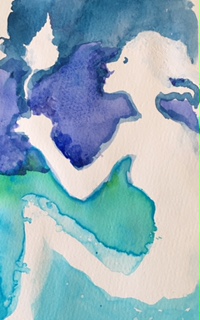
Tip: In case of a loss of white paper blot with damp towel and paint over with Golden absorbent ground. It is an opaque acrylic primer for water media that looks like and accepts paint like paper when it dries.  In the illustration the head of the girl was too small until several layers of opaque, absorbent ground formed a hard edge. The profile of her face was further developed by carving into the white with more background color making a smaller more delicate cameo profile.
The leg was enlarged by just blotting the paint to make a larger light area. Then I added a very wet paint in the newly formed negative area.  The extra wet area will form a line on the edge as it dries.


Below is a sample of my landscape painting: Landscapes tend to be more complex with a dominate subject and one or more supportive subjects. In very strong landscapes a group of subjects can be the focal point that draws the eye first. Secondary objects group together and will group with the space surrounding the dominate group or object.
This is cropped from a much larger painting. It was the part of the painting most expressive of springtime.
 
 
A student's landscape with a dominate tree is a focal point because of the great dark light contrast. The road is a secondary focal point grouping with the dark grasses, trees and sky.


During these two classes I was reminded that my students have some different needs and desires when they start to paint. Some come with an idea in their head but they don't have the skill set to paint. Some want to be entertained and expect to find painting relaxing. Some want their children to have the experience. The youngest child just is excited about the experience without any interest in the end product. Snatching their fun away before they are done is like taking away a toy.
 The class reminds me of a painter who loved an evening ritual of turning on her favorite music, lighting candles then making a puddle of water on her paper in which she drops several different colors and watches as it dries. Very relaxing!


There are two different directions for watercolor painting. The best book for the traditional path  is The Complete Watercolorist's Essential Notebook, by Gordon MacKenzie, North Light Books, ISBN-13: 978-1-4403-0905  The other direction is like the one in  my exercise. For this  more fluid approach using the character of paint an excellent guide is A Passion for Water Color, Painting the Inner Experience, by Stefan Draughon. Watson Guptilll publisher, ISBN 0-8230-0102-4
 
My next blog post will have links to artists who have used the principles in my painting exercise to advantage. They include Edward Hooper and Gustav Klimt.


Saturday, November 11, 2017

Sweethearts of the West

by Rain Trueax


When I made the decision to become an indie author, I was 68 years old. I had been writing books since I was in my teens. I've often joked that when I wrote the first draft of what became Round the Bend, I was the age of the heroine. When I made the decision to publish it, I was the age of what would have been her grandmother. The book went through as many metamorphoses in the intervening nearly fifty years as I had. During that time I never quit writing love stories with the Western ethos, set in the land I love and know best. Writing and what came later with publishing has led me down many paths.

This fall, when I was invited to join a group blog called Sweethearts of the West, I had to consider whether I had anything to offer. I read the articles by its other authors, liked the mix of history, Western Americana, and travel through the land west of the Mississippi River. With a diverse group of authors, you never know what will turn up, and every two days, it is something new.

In joining it, I left another group blog, Smart Girls Read Romance. I liked it also but had less feeling for what I could offer. Sweethearts is easier for me due to my love of western history, traveling Western states, and my own books. The big thing about joining a blog, for me, is feeling I have something to contribute.

One thing, if you are a writer, you learn that you have to write what comes to you. Okay, there are some writers, who write to the market, many because it's the support of their family, but for most, they try to blend that with what they love. A writer feels joy when writing to their core beliefs and loves-- as well as what they know best. This works for blogs as well as books. 


For my first piece there, I wrote a bit about my childhood and how that influences what I write. Where I've written more about my life today, I've written less about those growing and learning years. Some of that is because of what I wrote last week-- I don't think on those years much. Seeing how it mattered, how it was still a factor in who I am, I made myself go back there. Even more, I came to see how it still influences my books. Here is a snippet from that blog.
 A WWII baby, as I became a child, the United States was coming off a major war, and we were under the threat of a nuclear holocaust. If we could forget that, our schools had bomb shelters where we were supposed to go in the event of an attack (exactly what those were supposed to benefit us, I'm not sure as we all knew about the dangers of radiation).  Despite the Cold War and a soon to be hot one in Korea, I consider it a rich time in which to grow up.
So, head on over to the link where I did what I rarely do-- looked back at what influenced the woman I am today, the life I lead, and what I write. If you are interested in Western Americana, I think you'll like this group blog and learn something or have your memories refreshed by the articles.

Wednesday, November 08, 2017

Watercolor Class at Oregon State University with Oregon Fish and Wildlife Hatchery and Research Center Fall Creek Arts Festival

Saturday, November 4, at the OSFW Fish Hatchery and Research Center Arts Festival I enjoyed a morning and an aftenoon class of enthusiastic painters. Adult sisters assisted me and painted too. There were children accompanied by parents and one family included a grandparent, also some individuals with their caregivers. Everyone became engaged. 

Only have pictures of  a few of the paintings from the class.


  Attempting to be inclusive of painters in every stage of development including children and adults who knew what they wanted to paint. They were encouraged to go for their vision. For those who wanted a challenge or idea to start, I had an assignment for them.

My teaching exercise was on the techniques of  laying down a general compositional plan while being open to allowing the character of the paint to suggest new directions. Of course the creative process includes being free during the course of painting to reject somethings that are not desired. My goal was to disprove the widely held belief that watercolor is difficult because once a mistake is made the painting is ruined.  One reason watercolor is a workable medium is that the white of the paper can be restored by applying opaque, acrylic absorbent ground.
  
Lesson plan: With just two hours to paint, the assignment must be quickly explained leaving most of the time for the hands on exploring of watercolors. My challenge is great because students are four years old to ninty. Some had limited English language skills.  The basic need is to be simple and clear but still have enough meat to hook the most experienced painters.

Lesson: Very important! The placement of your subject within the picture is very, very important!   Deciding how much space surrounds the subject is your first step in making your painting expressive.   Whether tiny or popping out, whether placed to right or left top, middle or bottom determines the shape of the surrounding areas.  Whether the subject is small or large, the main subject and surrounding space project feelings and stories.


The size of the bird is significant as well as the central location. Top bird shows dominance, to be feared. the middle bird smallest with wings up in surrender. The bottom bird relatively big but is perceived as small because it is intimately close.

Student example of work using the technique of first painting negative area around subject while being mindful of allowing enough surrounding space to contribute to telling a story with emotion;

 
Whether the subject is recognizable or more abstract, the placement in the picture space is important to expressiveness.  My sample I cropped to make it more expressive:
 
A student's watercolor painting is  a  good example of the paint doing what it likes. Allowing paint to move and dry as it likes leads to happy accidental effects that if not fought can suggest a fun carefree ride to new imaginings. Watercolors have character in uneven coverage that painters can come to happily accept it's surprises.
 
In the next blog Wednesday, November 15, a demo will be illustrated and explained.